
Why is my Etsy shop not getting sales?
It’s one of the most common questions new Etsy sellers ask after launching their first products.
I spent a weekend reading Etsy seller forums so you don’t have to.
Not the success stories. The frustrated ones.
The threads where someone had been running their shop for three months, tweaking their titles every week, adding new listings, and still hadn’t made a single sale.
I read through more than 40 of them.
After a while, the same five problems kept showing up. Not ten. Not the usual bloated list you find everywhere else. Five. And most of them had nothing to do with what popular Etsy advice focuses on.
This article is what I found.
If your Etsy shop isn’t getting sales, at least one of these five reasons is probably why. More importantly, each one has a specific fix — not a vague suggestion, an actual change you can make this week.
Let’s get into it.
Table of Contents
Why Is My Etsy Shop Not Getting Sales?
The most common reasons an Etsy shop isn’t getting sales are poor keyword optimization (the listing isn’t showing up in search at all), a weak thumbnail (the listing shows up but nobody clicks it), no sales history (new listings get deprioritized by Etsy’s algorithm after the initial boost), a shop that looks incomplete or untrustworthy, and an audience mismatch (selling something buyers aren’t actively searching for on Etsy specifically).
Most beginners have at least two of these working against them at the same time — which is why fixing just one thing rarely moves the needle.
The sections below break each one down with a specific fix.
Why Most Etsy Advice Doesn’t Fix the Real Problem
Most articles about Etsy sales give you a list of twelve things to fix. Better photos. More keywords. Post on Pinterest. Start an email list.
The advice isn’t wrong exactly. It’s just not specific enough to be useful.
When I went through those 40+ Reddit threads, I wasn’t looking for a checklist. I was looking for patterns. Which problems were showing up again and again in shops that genuinely couldn’t get traction — not shops that were lazy or gave up too early, but shops where the seller was clearly trying.
What I found was that most struggling shops had the same core issues. And those issues fell into five categories every time.
I’m calling it the VISTA Framework — Visibility, Image, Sales History, Trust, and Audience. Not because it’s a magic formula, but because it’s a useful way to diagnose which specific problem your shop is actually dealing with instead of throwing fixes at the wall.
Work through each one below and be honest with yourself about which applies.
Reason 1 — Your Listing Isn’t Showing Up in Search
This is the most common problem and the hardest one to notice — because if your listing isn’t appearing in search, you won’t get views, and without views you have no way of knowing whether your product is actually good or not.
Etsy’s algorithm reads your listing title first. The keywords in your first 40 characters carry the most weight. If those characters contain vague phrases like “digital download” or “printable template” without telling Etsy exactly what the product is for, the algorithm has no idea who to show it to.
The second mistake is using seller language instead of buyer language. A seller might title their product “Minimalist Productivity System — Notion Template.” A buyer searches “weekly planner template for work.” Those are different phrases and Etsy treats them differently.
Here’s what actually works:
Search for your product on Etsy as if you were a buyer. Look at the autocomplete suggestions — those are real searches real buyers are making. Use that exact language in the first 40 characters of your title.
Then use all 13 tags. Each tag is a separate keyword phrase Etsy uses to match your listing to searches. Most new sellers use 6 or 7. Leaving tags empty is leaving visibility on the table.
Reason 2 — Your Thumbnail Isn’t Stopping the Scroll
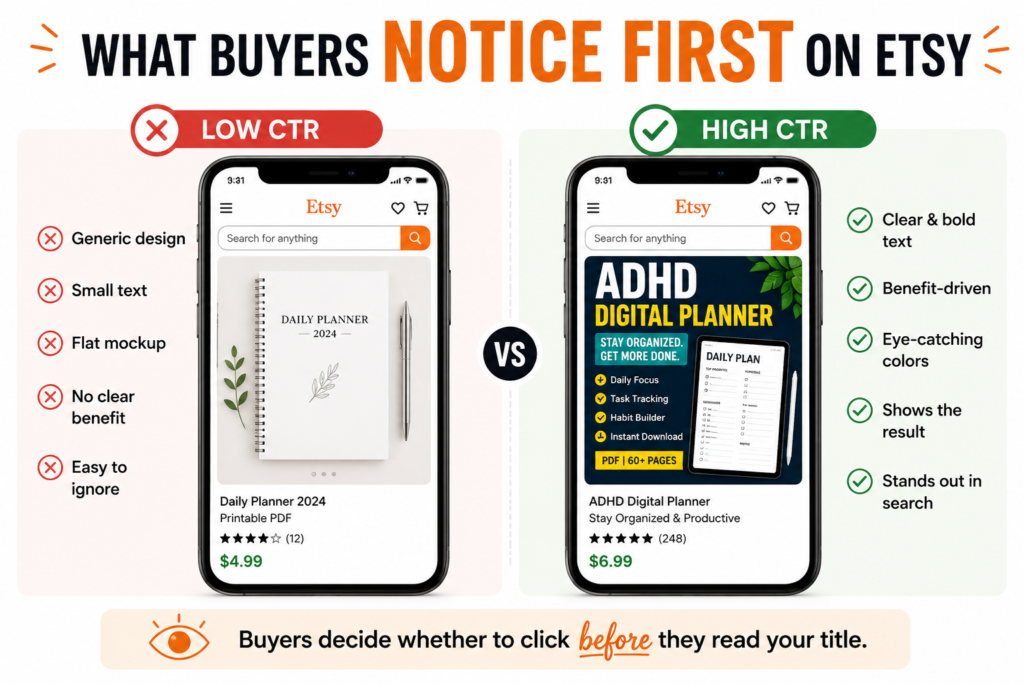
Your listing can have perfect keywords and still fail — if the thumbnail doesn’t make someone stop scrolling.
This matters more than most beginners realize. As of late 2025, 46% of all Etsy sales happen through the mobile app. That means nearly half of your potential buyers are scrolling through a small screen, moving fast, deciding in less than a second whether your listing is worth a tap.
A generic mockup with a white background and small text doesn’t stop that scroll.
What I kept seeing in seller forums was this pattern: someone would fix their SEO, their views would go up, but sales stayed flat. The listing was getting found. It just wasn’t getting clicked. That’s a thumbnail problem, not a keyword problem.
The fix isn’t complicated but it does require being honest about whether your current thumbnail looks different from the 50 other listings around it in search results.
Ask yourself three things. Does it show the result, not just the product? Is the most important information readable on a small screen? And does it look noticeably different from what’s already ranking?
If the answer to any of those is no, the thumbnail is your problem — not your SEO.
Reason 3 — The Algorithm Is Working Against New Listings
This one isn’t your fault — but it is your problem.
When you publish a new listing on Etsy, the algorithm gives it a short visibility boost. Your listing gets shown to a small pool of buyers to test how they respond. If they click, save, and buy — the algorithm rewards the listing with more visibility. If they don’t, the listing gets quietly deprioritized and replaced in search results by listings with proven engagement.
The problem is that new listings have no sales history, no reviews, and no engagement data. So even a well-optimized listing from a brand new shop is competing against listings that have been converting for months or years.
This creates a cycle that frustrates almost every new seller. No sales means less visibility. Less visibility means fewer chances to get sales. And without that first sale, the cycle is hard to break.
Etsy’s algorithm in 2026 heavily weights what it calls sales velocity — how recently and how frequently a listing has sold. A listing that sold yesterday outranks one that hasn’t sold in three months, even if the older listing has better keywords.
Here’s how to break the cycle early:
Run a short launch discount of 20–30% for the first 48 hours after publishing. Share the listing in relevant communities where your target buyer actually spends time. If you have friends or family who genuinely need the product, ask them to make the first purchase. That first sale changes how the algorithm treats your listing more than almost anything else you can do.
Reason 4 — Your Shop Doesn’t Look Trustworthy Yet
Getting someone to click your listing is only half the battle. The other half is convincing them to actually buy once they land on your shop.
This is where a lot of new sellers lose sales they should have made.
A buyer clicks your listing, likes what they see, then instinctively checks the rest of your shop. They look at how many other listings you have. They check for reviews. They glance at your shop banner, your about section, your policies. They’re not doing this consciously most of the time — it’s a trust check that happens in a few seconds.
If they land on a shop with two listings, no banner, no reviews, and an empty about section, most of them leave. Not because your product is bad. Because the shop doesn’t look like a real business yet.
Data from successful Etsy sellers consistently shows that shops with 20 or more active listings earn significantly more than shops with fewer than five. More listings create more entry points for buyers to find you, more keyword coverage across Etsy search, and a shop that looks established rather than experimental.
You don’t need 20 listings before you can make sales. But you do need to make your shop look intentional from the moment someone lands on it.
Fill every section. Add a banner. Write an about section that explains who you are and what problem your products solve. Set up your policies. These take less than an hour and they directly affect whether a first-time visitor becomes a buyer.
Reason 5 — You Might Be Selling to the Wrong Audience
This is the reason most articles skip — because it’s uncomfortable to say and harder to fix than tweaking a title or updating a thumbnail.
But it came up repeatedly in the forums I read. Sellers who had done everything right — good SEO, strong thumbnails, complete shop profiles — and still couldn’t make sales. In many of those cases, the product itself wasn’t something buyers were actively searching for on Etsy specifically.
Etsy is not Amazon. It’s not Google. Buyers come to Etsy looking for specific things — handmade items, personalized gifts, digital downloads that solve a real and specific problem. If your product doesn’t fit naturally into what Etsy buyers are already searching for, no amount of optimization is going to fix that.
The mistake most beginners make is choosing a niche based on what looks popular rather than what has genuine demand with manageable competition. They see wall art selling well so they make wall art. They see planners everywhere so they make another planner. Then they wonder why their version isn’t getting traction in a category with fifty thousand competing listings.
The research has to come before the product. That’s one of the biggest lessons I learned while researching low-competition Etsy niches.
The most useful signal I found wasn’t inside Etsy at all. It was in hobby communities on Reddit — places where people were openly asking for products that didn’t exist yet, building their own spreadsheets because they couldn’t find what they needed, describing problems that nobody had solved for them yet.
That kind of demand is real. And it usually shows up in communities long before it shows up in keyword tools.
What I Almost Included But Didn’t
When I started this research I had a longer list.
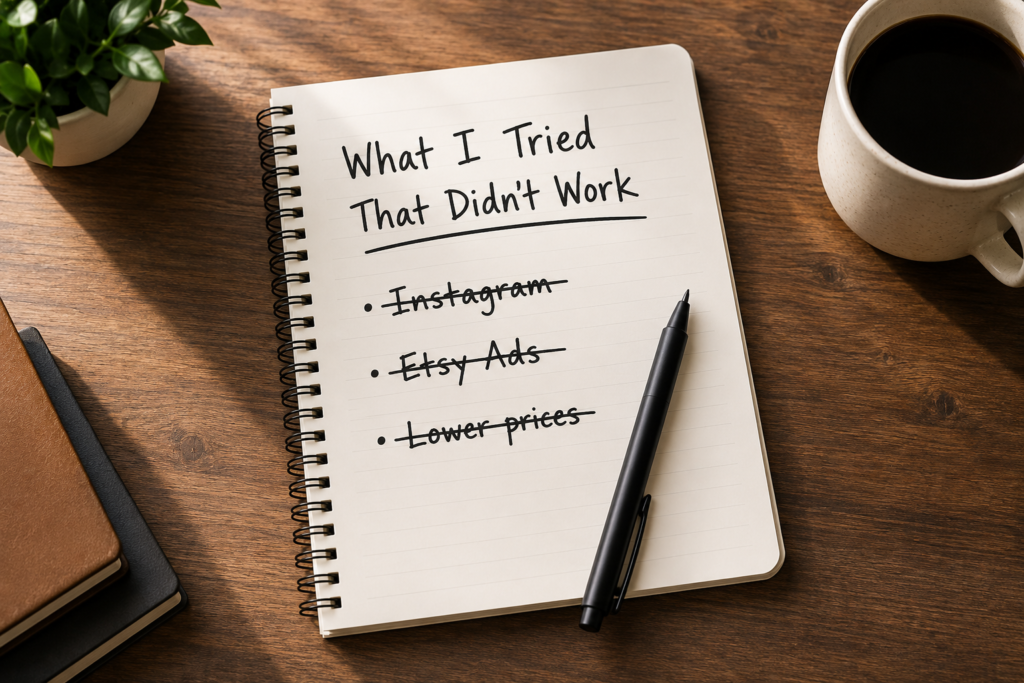
Not using social media was on it. So was not running Etsy ads. So was pricing too high.
The more I dug into real seller discussions the more I realized those reasons were either secondary symptoms or outright myths.
Most beginners don’t fail because they’re not on Instagram. They fail before anyone ever sees their shop — because the listing isn’t showing up in search, or the thumbnail isn’t getting clicked, or the shop looks empty and unfinished. Social media might help an already-working shop grow faster. It won’t save a shop with broken fundamentals.
Etsy ads came up a lot too. Plenty of sellers mentioned turning on ads hoping it would fix their sales problem. It usually didn’t. Ads amplify what’s already working. If your listing isn’t converting organically, paying to show it to more people just burns through your budget faster.
Pricing too high was another one I almost included. But when I looked at the actual data, underpricing was far more common and far more damaging than overpricing. Buyers on Etsy associate price with quality in a way that catches new sellers off guard. A $3 digital template doesn’t feel like a bargain — it feels like something that probably isn’t very good.
I left all three off the main list because they distracted from the five things that actually matter first.
Fix the foundation before you worry about anything else.
Frequently Asked Questions
How long does it take to get your first sale on Etsy?
Most new Etsy digital product shops take between two weeks and three months to make their first sale. The range is wide because it depends heavily on niche competition, how well the listing is optimized, and how many products the shop has. Shops with 10 or more listings that target specific low-competition keywords tend to reach their first sale significantly faster than shops with one or two generic listings.
Why do I have views but no sales on Etsy?
Views without sales almost always means your listing is showing up in search but failing to convert once buyers click through. The most common causes are a product description that doesn’t close the sale, pricing that feels off for the category, a shop that looks incomplete or untrustworthy, or a thumbnail that attracted the wrong type of buyer. Fix the listing page itself before changing anything else.
How many listings do I need before Etsy starts showing my shop?
There is no official minimum but data from established Etsy sellers consistently shows that shops with 20 or more active listings earn significantly more than shops with fewer than five. More listings create more entry points in search, more keyword coverage, and a shop that looks established rather than experimental. Aim for at least 10 before expecting consistent traffic.
Does Etsy penalize new shops in search results?
Etsy doesn’t officially penalize new shops but the algorithm heavily favors listings with proven sales history and engagement data. New listings receive a short visibility boost when first published. Without early sales that boost fades quickly and the listing gets replaced by listings with stronger conversion signals. This is why the first sale is disproportionately important — it changes how the algorithm treats everything that follows.
Final Thoughts
Most articles about Etsy sales problems give you a long list and send you off to fix everything at once. That approach rarely works because it doesn’t help you identify which specific problem your shop is actually dealing with.
The VISTA Framework exists for exactly that reason. Visibility, Image, Sales History, Trust, Audience. Work through each one in order and be honest about where your shop is actually falling short. Most struggling shops have one or two core issues — not all five.
If you haven’t made your first sale yet the most likely culprit is visibility or trust. Your listing either isn’t showing up in search or buyers are landing on your shop and leaving because it doesn’t look established enough yet.
If you’re getting views but no sales the problem is almost always your thumbnail or your listing page. The traffic is there — something on the page is stopping the conversion.
And if you’ve fixed all of the above and still aren’t getting traction it might be worth going back to the beginning and asking whether there’s genuine demand for what you’re selling on Etsy specifically. That’s not a failure — it’s the most useful information you can have.
And if you’re still deciding what type of digital product to create, starting with proven opportunities can save months of trial and error. Once your shop starts getting consistent traffic, pricing becomes the next thing most sellers get wrong. I made this mistake myself and wrote about exactly how to fix it using the Floor-First Pricing Method in my guide on how to price digital products on Etsy.
The research always comes first. The pricing comes right after.
Pingback: Should I Sell on Etsy and Gumroad at the Same Time? (2026 Guide)
Pingback: How to Sell Digital Products With No Audience
Pingback: How to Write an Etsy Listing for Digital Products