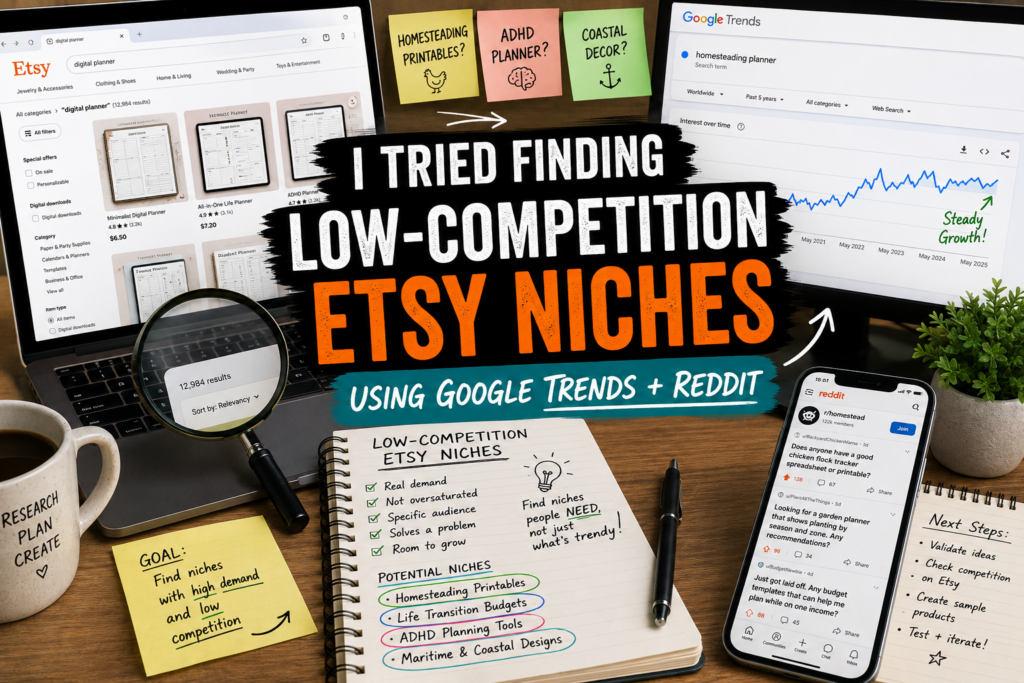
Most articles about low competition Etsy niches for beginners recommend the same ideas.
Sell planners.
Sell wall art.
Sell mugs.
Sell wedding templates.
After reading enough of these lists, I started wondering if anyone was actually researching new opportunities anymore or if everyone was just copying the same advice from each other.
So instead of paying for tools like eRank or EverBee, I decided to spend a weekend using two completely free resources:
- Google Trends
My goal was simple: find low-competition Etsy niches for beginners that weren’t already being talked about everywhere.
A few hours later, I had dozens of ideas, several dead ends, and a handful of niches that genuinely surprised me.
Here’s what I found.
Table of Contents
Why I Stopped Trusting Most Etsy Niche Lists
The more Etsy niche articles I read, the more they started to sound identical.
One blog would recommend printable planners.
Another would recommend printable planners.
A YouTube video would recommend printable planners.
At some point, I realized everyone seemed to be copying the same handful of ideas from each other.
The problem isn’t that these niches are bad.
The problem is that thousands of new sellers are being pointed toward the exact same opportunities.
When every beginner reads the same advice, competition builds quickly.
I saw this happen repeatedly with things like:
- Daily planners
- Generic budget templates
- Printable wall art
- Wedding invitations
- Motivational quote prints
Most of these markets already have tens of thousands of listings competing for attention.
That doesn’t mean you can’t succeed there. It just means the odds aren’t exactly in your favor when you’re starting from scratch.
Instead of looking for the next popular Etsy niche, I wanted to find areas where people were actively looking for solutions but fewer sellers seemed to be paying attention.
That’s why I stopped looking at Etsy niche lists and started looking at communities instead.
How I Researched Low-Competition Etsy Niches
I didn’t want to spend money on Etsy research tools before I even knew whether an idea was worth pursuing.
So instead of paying for premium software, I used tools that anyone can access for free.
The goal wasn’t to find the next viral Etsy trend.
I was looking for products and niches that already had demand but weren’t being discussed in every Etsy seller group and blog post.
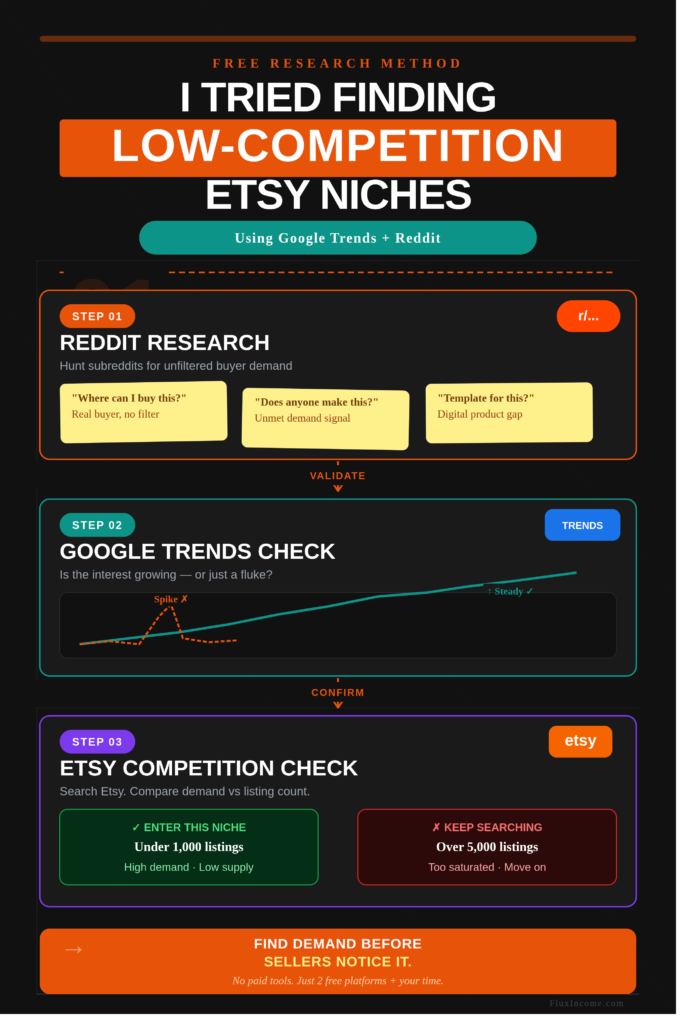
After testing a few different approaches, I settled on a simple process:
- Find problems people are talking about on Reddit.
- Check whether interest is growing using Google Trends.
- Search Etsy to see how much competition already exists.
If an idea passed all three checks, it went onto my shortlist.
What surprised me most was how many opportunities appeared once I stopped looking directly at Etsy and started paying attention to communities instead.
My Research Process
For every niche idea, I followed the same process.
First, I searched Reddit communities where people actively discuss hobbies, problems, and purchases.
I paid attention to posts where people asked questions like:
- Does anyone know where I can buy this?
- Is there a template for this?
- I wish someone made this.
Those questions often reveal demand before sellers notice it.
Next, I checked Google Trends.
I wasn’t looking for sudden spikes.
I was looking for steady interest over time because those trends tend to be more sustainable.
Finally, I searched Etsy itself.
If a keyword already had tens of thousands of competing listings, I usually moved on.
If competition looked reasonable, I kept researching.
After reviewing more than 30 ideas, four niches stood out.
What I Actually Found
After reviewing more than 30 ideas, a few patterns started appearing.
The niches that looked most promising weren’t the ones every Etsy YouTube channel talks about.
They were smaller, more specific, and often connected to communities with passionate buyers.
Some were physical products.
Others were digital products.
What surprised me most was how often demand showed up on Reddit long before it became obvious on Etsy.
Here are the four niches that stood out the most during my research.
Functional Digital Products for Hobby Communities
This was probably the most surprising discovery.
When people think about Etsy digital products, they usually think about planners, wall art, or printable quotes.
What I kept finding instead were hobby communities looking for practical tools.
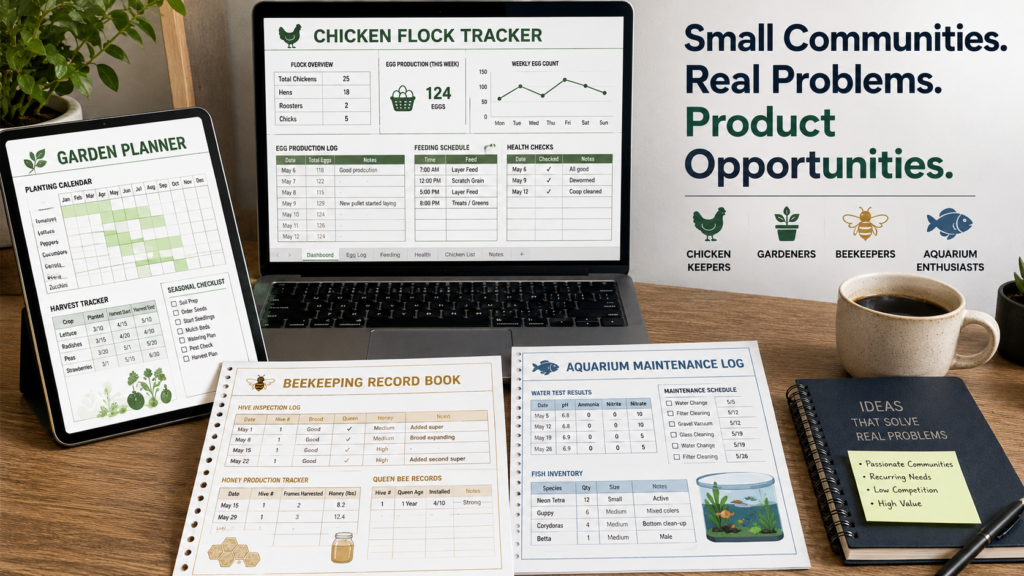
One example was backyard chicken owners.
While browsing communities focused on chicken keeping and homesteading, I noticed people frequently discussing flock management, egg production tracking, feeding schedules, and health records.
Many were using spreadsheets they created themselves.
Others were asking if better tracking systems existed.
That immediately caught my attention.
The community itself is huge. The Backyard Chickens community has millions of members and highly engaged discussions every day, yet there aren’t nearly as many specialized digital products available as you’d expect.
Instead of generic planners, there may be opportunities for products such as:
- Chicken flock trackers
- Egg production logs
- Feeding schedule planners
- Breeding record sheets
- Seasonal care checklists
What stood out wasn’t just demand.
It was that people were actively trying to solve a problem.
The same pattern appeared in other hobby communities too.
Gardeners wanted planting trackers.
Aquarium owners wanted maintenance logs.
Beekeepers wanted record-keeping templates.
In many cases, people were creating their own systems because they couldn’t find exactly what they needed.
For beginners looking for low-competition Etsy niches, that’s often a stronger signal than search volume alone.
When people start building their own spreadsheets, there’s usually a product opportunity hiding nearby.
I wouldn’t classify hobby-community products as a guaranteed winner.
But compared to another generic budget planner or wall art design, the competition appears significantly lower while the audience is often more passionate and engaged.
Life-Transition Budget Templates
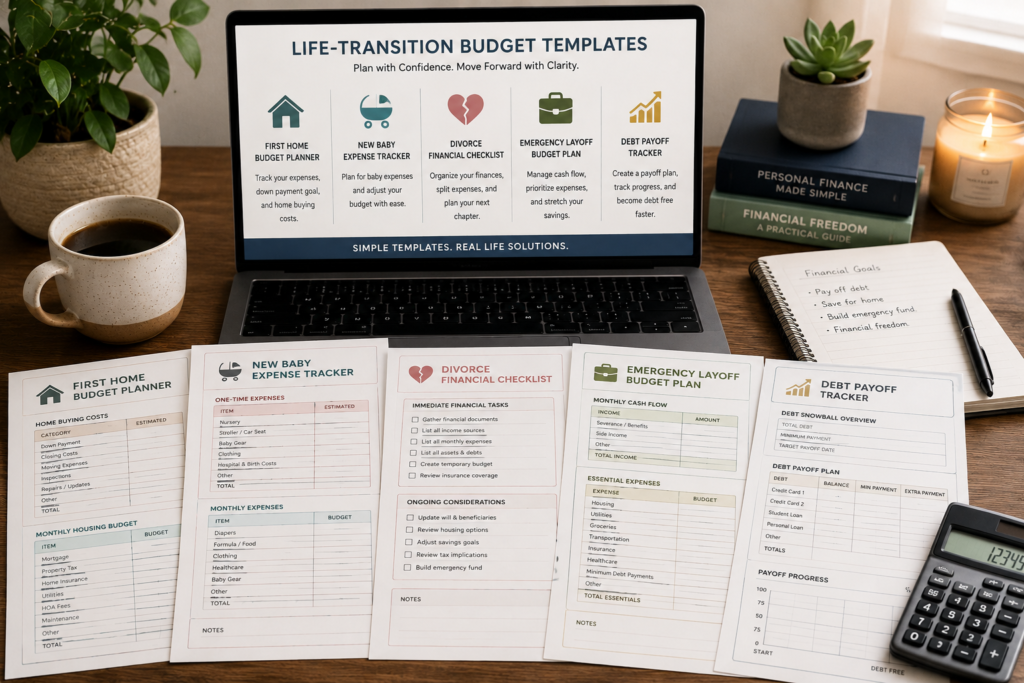
People don’t usually search for a budget spreadsheet because they enjoy budgeting.
Most people start looking when something major changes in their life.
A new job.
A new baby.
A first home purchase.
A divorce.
A sudden layoff.
While researching low-competition Etsy niches for beginners, I noticed that most financial templates on Etsy are extremely broad. They try to help everyone, which means they don’t feel particularly useful to anyone.
I searched Reddit communities focused on personal finance and life transitions and found the same pattern repeatedly.
People weren’t asking for generic monthly budget planners.
They were asking specific questions tied to a situation they were experiencing.
Examples included:
- Budgeting after a divorce
- Planning finances for a first home purchase
- Managing expenses after having a baby
- Job-loss emergency budget planning
- Debt payoff plans for specific income levels
The more specific the situation became, the fewer products I found addressing it.
This surprised me because the demand was clearly visible.
People were actively looking for help, sharing spreadsheets they built themselves, and asking others for templates.
Whenever I see people creating their own tools from scratch, I take that as a sign that an opportunity may exist.
If a problem is important enough for someone to build a spreadsheet at midnight, there’s a good chance they would pay a few dollars for a better version.
What stood out wasn’t the search volume.
It was the emotional urgency.
Someone planning a kitchen renovation can wait.
Someone navigating a divorce or job loss usually can’t.
That urgency often creates stronger buying intent because people are actively searching for solutions rather than casually browsing.
For beginners looking for Etsy niche ideas, this type of focused problem-solving felt far more interesting than creating another generic budget planner.
The lesson here was simple:
The more specific the life situation, the less competition I found.
Instead of selling a budget template for everyone, it may be smarter to create a solution for one specific financial challenge.
Natural Texture Home Decor

While digging through Etsy bestsellers, I kept seeing the same types of products dominate the home decor category.
Minimalist prints.
Boho wall art.
Neutral line drawings.
They all looked nice, but they also felt incredibly familiar.
So I stopped looking at Etsy and started paying attention to where buyers were actually talking.
I browsed r/mossart, r/interiordesign, and a few home decor communities on Reddit. The same theme kept appearing across all of them — people weren’t sharing flat prints. They were sharing textured pieces that added depth and warmth to a space.
What caught my attention wasn’t just the posts themselves. It was the comments.
People were asking where to buy specific pieces. Others were saying they’d searched everywhere and couldn’t find anything quite like it. A few mentioned trying to make their own versions.
That pattern — wanting something, not finding it, attempting to DIY it — is the same signal I saw in the hobby community niche and the ADHD niche.
Examples of what people were drawn to included:
Handmade ceramic decor
Moss wall art
Textured plaster wall panels
Woven wall hangings
Natural fiber accents
What surprised me was the gap between how much interest existed and how repetitive the Etsy listings looked. Many felt mass-produced rather than handcrafted.
The strongest sellers in this space weren’t competing on price. They were competing on feel — and charging significantly more because of it.
This niche stood out because buyers aren’t simply purchasing decoration. They’re buying a feeling. A calmer home. A more natural environment. A space that feels intentionally designed rather than assembled from a cart.
That emotional connection tends to support higher prices and stronger loyalty than most decor categories.
The biggest takeaway wasn’t that moss art or woven decor is guaranteed to succeed. It was that buyers seem increasingly interested in products that add texture and character rather than just another picture for the wall.
When a trend reflects how people want their homes to feel, it tends to have more staying power than one built around how things look.
Neurodivergent and ADHD-Friendly Products
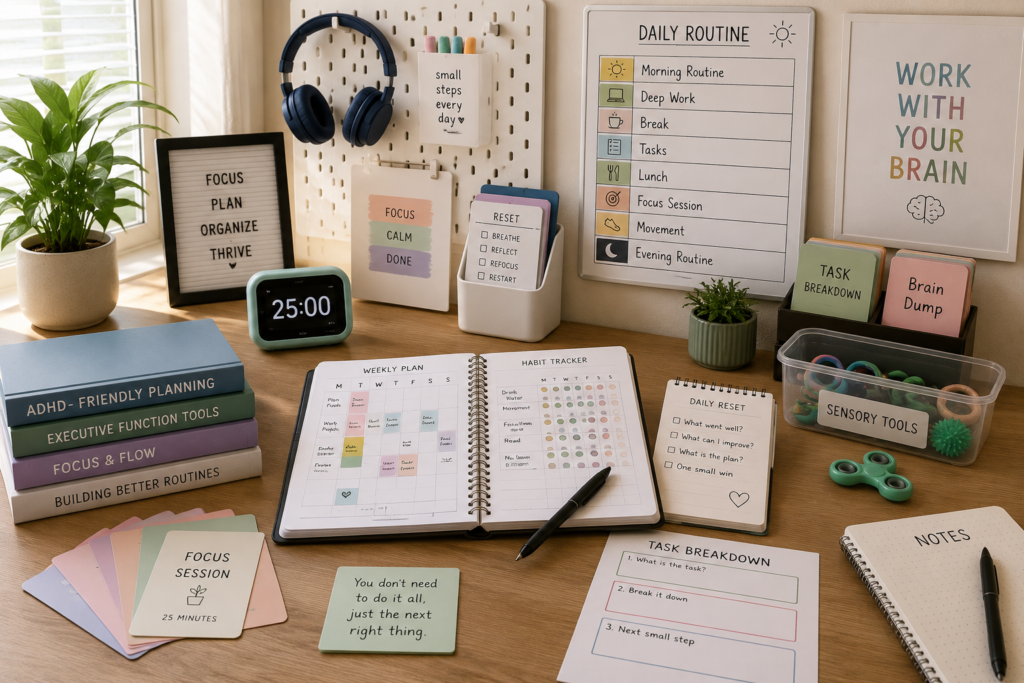
This niche wasn’t even on my radar when I started researching.
I stumbled across it while browsing Reddit communities where people were discussing productivity, focus, and daily routines.
What caught my attention was how often people were creating their own systems.
They weren’t asking for generic planners.
They were looking for tools that worked with the way their brains functioned.
Many people mentioned struggling with traditional productivity methods.
They wanted visual reminders.
Simple habit trackers.
Routine cards.
Focus aids.
Task breakdown systems.
The demand felt different from other niches because people weren’t searching for motivation.
They were searching for practical solutions.
I also noticed that many existing Etsy products looked like standard planners with different colors.
Very few seemed specifically designed around the challenges people were describing.
That gap between real-world problems and available products stood out immediately.
Examples included:
- Visual routine planners
- ADHD-friendly task trackers
- Focus session templates
- Executive function worksheets
- Printable organization systems
- Daily reset checklists
Unlike trend-based niches, these products solve recurring problems.
Someone who finds a system that genuinely helps them stay organized is often willing to recommend it to others.
That’s one reason this niche felt especially interesting during my research.
The biggest lesson wasn’t that ADHD products are easy to sell.
It was that communities with very specific challenges often create opportunities for products that are genuinely useful.
When people repeatedly build their own workarounds, there’s usually a product opportunity hiding nearby.
What Didn’t Make the Final List
Not every niche I researched looked promising.
A few actually seemed interesting at first but became less attractive the deeper I looked.
The biggest example was generic printables.
Budget planners.
Habit trackers.
Meal planners.
Study planners.
The demand is obviously there.
The problem is that thousands of sellers already know it.
When I searched Etsy, many of these categories had tens of thousands of competing listings.
For a beginner, that’s a difficult environment to enter.
I also looked at generic motivational wall art.
The competition was even worse.
Most listings looked nearly identical, which made it difficult to imagine standing out without a large marketing budget.
Another niche I crossed off my list was trendy viral products.
These often show huge spikes on Google Trends, but the interest usually fades as quickly as it appears.
I wasn’t looking for a niche that might work for a few weeks.
I was looking for niches with signs of long-term demand.
That process eliminated a lot of ideas.
The four niches that survived weren’t necessarily the biggest opportunities.
They were simply the ones where demand seemed real and competition looked reasonable.
Final Thoughts
Final Thoughts
When I started this research, I was hoping to find a secret Etsy niche that nobody had discovered yet.
I didn’t find one.
What I found instead was that the best opportunities usually aren’t hidden inside keyword tools. They’re hidden inside communities.
Again and again, I noticed the same pattern.
People were asking questions.
They were looking for solutions.
Sometimes they were even creating spreadsheets, trackers, and templates for themselves because they couldn’t find exactly what they needed.
That’s the kind of signal that caught my attention.
A similar research-first approach helped me uncover Canva template opportunities on Etsy as well, and it reinforced the same lesson: real demand usually shows up in communities long before it shows up in niche lists and keyword tools.
The four niches in this article aren’t guaranteed winners.
No niche is.
But they all have something that many popular Etsy categories no longer have: room to stand out.
If you’re trying to find low-competition Etsy niches for beginners, my advice is simple.
Spend less time looking at what sellers are already doing.
Spend more time listening to what buyers are talking about.
Browse Reddit.
Check Google Trends.
Pay attention to hobby groups, niche communities, and problem-solving discussions.
That’s where I found the most interesting opportunities during this research project.
And it’s probably where I’ll start the next time I go looking for one.
Pingback: How to Price Digital Products on Etsy the Right Way
Pingback: Why Is My Etsy Shop Not Getting Sales? 5 Problems Most Sellers Miss
Pingback: Should I Sell on Etsy and Gumroad at the Same Time? (2026 Guide)
Pingback: How to Sell Digital Products With No Audience