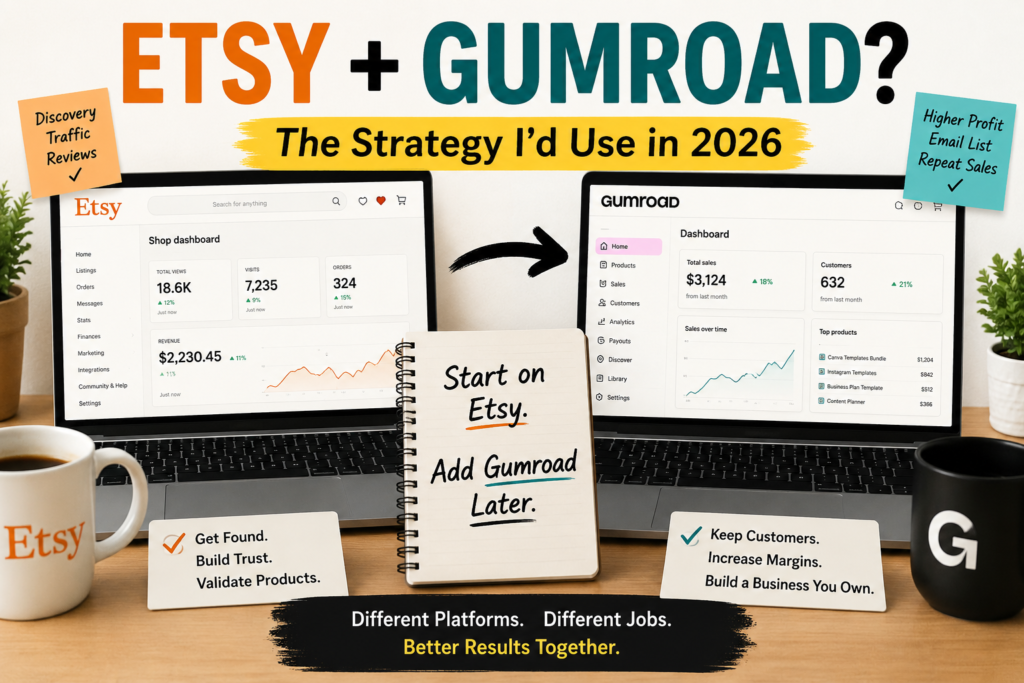
Should I sell on Etsy and Gumroad at the same time?
It’s one of the most common questions digital product sellers ask after making their first few sales. The answer depends on where you are in your business journey.
Every Etsy vs. Gumroad article I read seemed to arrive at the same conclusion. Use both.
The strange part was that nobody seemed to agree on what that actually meant.
Some creators recommended starting on Etsy and moving to Gumroad later. Others suggested launching both at the same time. A few argued that Gumroad was the better choice from day one because of the higher margins and built-in email marketing tools.
At first, I assumed there would be a clear answer.
Instead, the more sources I read, the more I noticed that everyone was answering a slightly different question.
Most people compare Etsy and Gumroad as if you have to choose one. But when I looked at how successful digital product sellers actually operate, that wasn’t what they were doing at all.
Many of them were using both platforms.
The real question wasn’t whether Etsy was better than Gumroad.
It was when adding a second platform actually makes sense.
And that’s the part almost nobody explains.
The Short Answer
If you’re looking for a simple yes-or-no answer, my view is that most digital product sellers should eventually use both Etsy and Gumroad.
The reason isn’t that one platform is better than the other. It’s that they solve different problems.
Etsy gives you access to an existing marketplace where buyers are already searching for products. Gumroad gives you more control over pricing, customer relationships, and repeat sales.
That’s why many experienced sellers end up using both.
The challenge is timing.
Launching a second platform too early can split your attention before you’ve proven that your products actually have demand. Waiting too long can leave money on the table if you’re already generating consistent sales and building an audience.
So before deciding whether you need both platforms, it helps to understand what role each one plays in the bigger picture.
Table of Contents
Etsy vs. Gumroad Isn’t the Real Question
Most comparisons between Etsy and Gumroad focus on features.
They compare transaction fees, customization options, email marketing tools, and how much control you have over your store.
Those differences matter, but they don’t explain why so many successful sellers end up using both platforms at the same time.
When I started researching this topic, I expected to find a clear winner.
Instead, I kept seeing the same pattern.
Sellers weren’t choosing Etsy because it had lower fees. They weren’t choosing Gumroad because it had better tools. They were choosing platforms based on what they needed at a particular stage of their business.
A new seller with no audience faces a completely different problem than someone who already has customers and repeat buyers.
That’s why comparing Etsy and Gumroad as direct competitors can be misleading.
The more useful question is this:
What job do you need the platform to do right now?
If your biggest challenge is getting discovered, the answer may be different than if your biggest challenge is increasing profit margins or building direct relationships with customers.
What Each Platform Actually Takes
One of the first things people compare when evaluating Etsy and Gumroad is fees.
On the surface, that makes sense. If two platforms help you sell the same product, the platform taking less money should be the better choice.
The reality is a little more complicated.
A platform that charges lower fees but sends you no customers can be more expensive than a platform with slightly higher fees that consistently brings buyers to your listings.
That’s why looking at fees in isolation often leads people to the wrong conclusion.
Still, it’s useful to understand what you’re paying for.
On a $100 sale, Gumroad takes roughly $13.20 in total fees — a 10% platform fee plus 2.9% and $0.30 in payment processing. Etsy takes about $9.95 — a 6.5% platform fee plus 3% and $0.25 in processing.
The difference isn’t huge. About $3.25 on every $100 you make.
But that small gap matters less than where the $100 came from in the first place.
The bigger difference isn’t usually the fee itself. It’s where the customer came from.
With Etsy, part of what you’re paying for is access to a marketplace where millions of buyers are already searching for products. With Gumroad, you’re paying for tools that help you sell directly to an audience you bring yourself.
In other words, Etsy charges for discovery.
Gumroad charges for ownership.
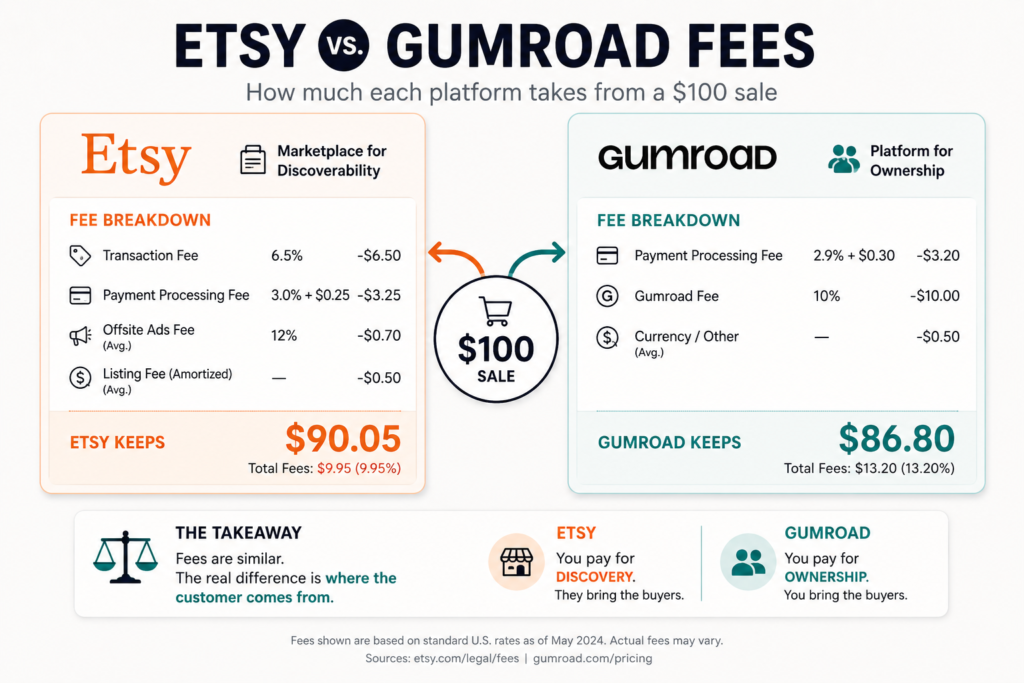
Of course, fee comparisons only tell part of the story. The more interesting question is how successful sellers are actually using these platforms in the real world.
What Happened When One Seller Used Both
At this point, the obvious question is whether using both platforms actually works in practice.
One example I came across while researching this topic was a digital product seller named Marie. Instead of choosing Etsy or Gumroad, she used both.
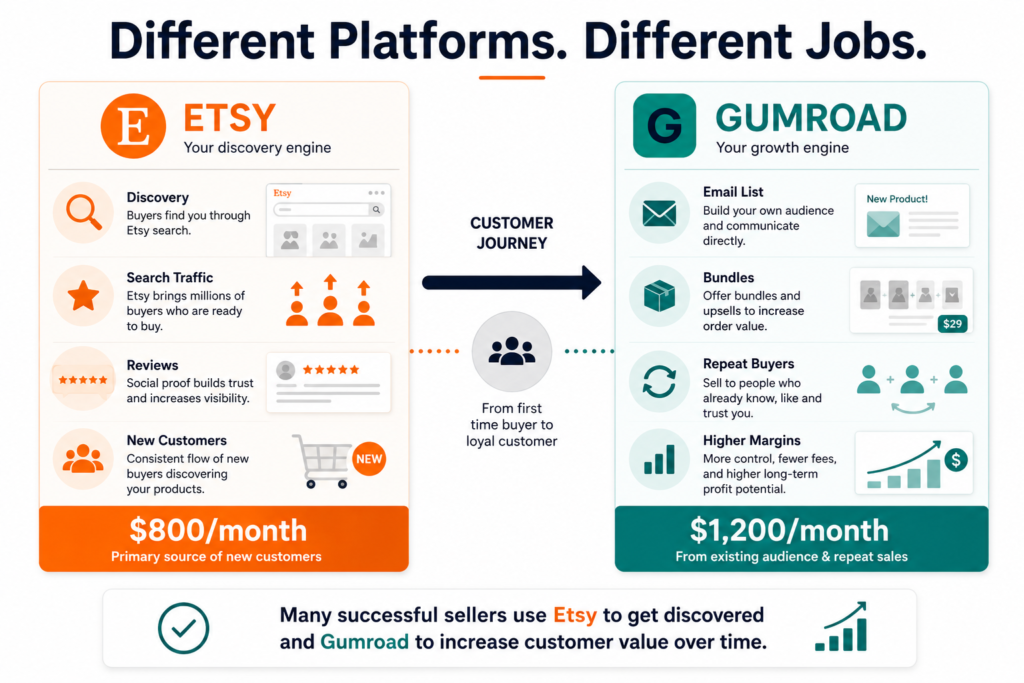
Her Etsy shop generated roughly $800 per month and acted as the primary source of new customers. Buyers discovered her products through Etsy search, reviews, and marketplace traffic.
At the same time, her Gumroad store generated around $1,200 per month by selling to people who already knew her work. The platform gave her more flexibility with bundles, customer communication, and repeat purchases.
What stood out wasn’t that Gumroad produced more revenue. It was that Etsy was still doing the job Gumroad couldn’t: discovery.
Without Etsy bringing new people into the funnel, there would have been far fewer customers available to buy from her Gumroad store in the first place.
That’s why I think many platform comparisons miss the bigger picture.
The goal isn’t necessarily to replace one platform with another.
It’s to let each platform do the job it’s best at.
Once I started looking at Etsy and Gumroad this way, a pattern began to emerge.
The sellers getting the best results weren’t choosing one platform over the other. They were using them at different stages of the same business.
The Discovery-to-Direct Method
After looking at seller case studies, platform comparisons, and creator discussions, I kept seeing the same sequence play out.
Most successful digital product businesses didn’t start with a website, an email list, or a complicated sales funnel.
They started with discovery.
Once they had proof that people wanted what they were selling, they gradually shifted toward building a more direct relationship with customers.
That’s why I think of Etsy and Gumroad as part of a two-stage process rather than two competing platforms.
I call it the Discovery-to-Direct Method.
The idea is simple.
Use Etsy to get discovered.
Use Gumroad to strengthen customer relationships once you already have momentum.
The exact timing will vary from seller to seller, but the overall pattern shows up surprisingly often.
Phase 1: Build Discovery on Etsy
For most beginners, the hardest part isn’t creating a product.
It’s getting someone to notice it.
That’s where Etsy has a major advantage.
Every day, buyers visit Etsy looking for digital downloads, planners, templates, printables, and other products. Instead of creating demand from scratch, you’re placing your products in front of people who are already searching.
This doesn’t guarantee sales, but it does give you something most standalone stores don’t provide:
Visibility.
The goal during this phase isn’t maximizing profit margins. It’s validating demand, collecting reviews, learning which products buyers respond to and identifying niches with proven demand. And understanding what the market actually wants.
Discovery comes first.
Optimization comes later.
Phase 2: Add Gumroad Once You Have Proof
The second phase starts once you’ve proven that people actually want what you’re selling.
At this point, the challenge changes.
Instead of wondering whether your products have demand, you’re thinking about increasing profit margins, encouraging repeat purchases, and building stronger relationships with customers.
That’s where Gumroad becomes much more interesting.
Because you’re no longer relying entirely on marketplace traffic, features like email marketing, product bundles, and direct customer communication become more valuable.
This doesn’t mean you should abandon Etsy.
In fact, many sellers continue using Etsy as their primary discovery channel while gradually building a second revenue stream through Gumroad.
The key is that Gumroad works best when it has something to build on.
An audience of buyers, customer feedback, successful products, or proof that people are already willing to spend money on what you’re offering.
That’s why I wouldn’t think of Gumroad as a starting point.
I’d think of it as the next step after validation.
Of course, every strategy sounds good in theory.
The real question is what happens when someone skips the discovery stage entirely and starts with Gumroad from day one.
Why Starting on Gumroad First Usually Fails
One reason Gumroad looks attractive to beginners is that it offers more control.
You own the customer relationship. You can build an email list from day one. You have more flexibility over pricing, product bundles, and the overall buying experience.
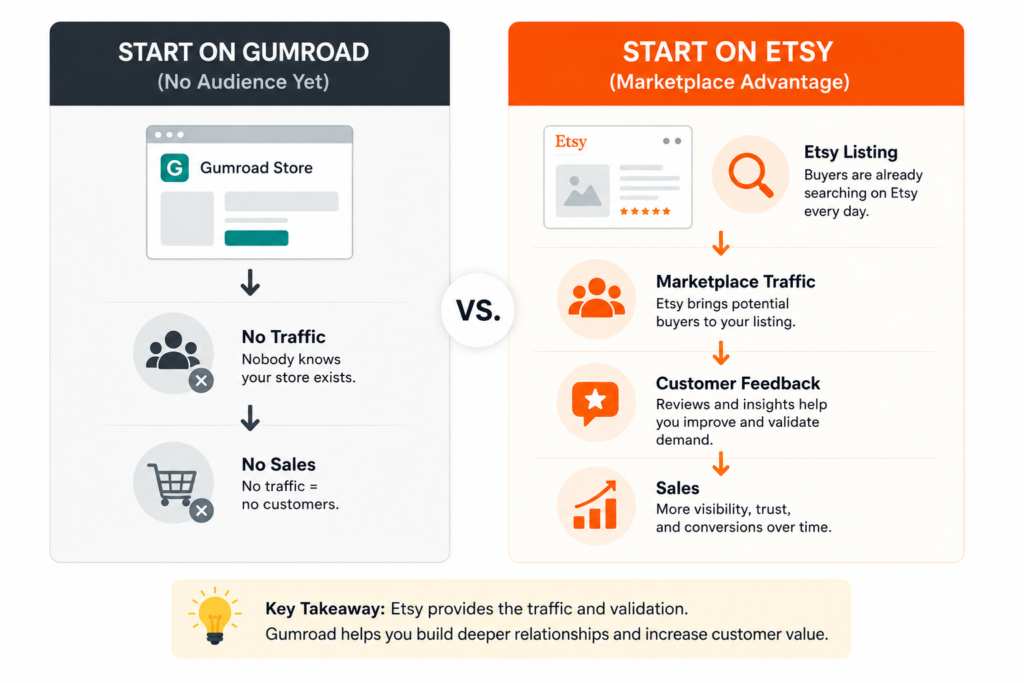
The problem is that none of those advantages matter if nobody knows your store exists.
Unlike Etsy, Gumroad isn’t a marketplace where buyers actively search for products. Most sales come from an audience you build yourself through content, social media, email marketing, or other traffic sources.
For creators who already have an audience, that can work extremely well.
For someone starting from zero, it creates a difficult challenge.
Instead of focusing on improving products and collecting customer feedback, you suddenly have to learn marketing, traffic generation, audience building, and content creation at the same time.
That’s why many beginners mistake platform choice for the real problem.
The issue usually isn’t Etsy or Gumroad.
It’s the lack of a reliable way to get in front of potential customers.
And for many new sellers, Etsy solves that problem faster than a standalone store can.
Common Mistakes When Selling on Both Platforms
Using Etsy and Gumroad together can work extremely well, but there are a few mistakes that show up repeatedly.
The first is expanding too early.
Some sellers create an Etsy shop, a Gumroad store, a website, a Pinterest account, and three social media profiles before they’ve made their first sale. Instead of building momentum, they end up splitting their attention across too many platforms.
Another common mistake is treating both platforms exactly the same.
If every product, description, and offer is identical, there’s very little reason for customers to engage with your business beyond the initial purchase. Many successful sellers use Gumroad for bundles, bonuses, or products that don’t fit neatly inside Etsy’s marketplace structure.
Pricing can also create problems.
Customers notice when the same product has dramatically different prices across platforms. If you’re selling in both places, make sure there’s a clear reason for any difference in pricing or packaging.
Finally, many sellers focus so much on opening a second platform that they forget to improve the first one.
A second store won’t fix a product that nobody wants or a listing that isn’t getting discovered.
Growth usually comes from improving what’s already working, not multiplying what’s already broken.
Frequently Asked Questions
Should I Sell on Etsy and Gumroad at the Same Time?
For most beginners, Etsy is usually the easier starting point because it already has buyers searching for products. Gumroad can be extremely powerful, but it works best when you already have an audience, customer base, or proven product.
Can I sell the same product on Etsy and Gumroad?
Yes. Many creators sell the same digital products on both platforms. The key is understanding that each platform serves a different purpose. Etsy often helps attract new customers, while Gumroad can be used to build direct relationships and encourage repeat purchases.
When should I add Gumroad to my Etsy business?
There isn’t a universal number, but a good rule of thumb is to consider Gumroad once you’ve validated demand. If you’re consistently getting sales, receiving customer feedback, and understanding which products perform best, adding Gumroad can help you increase customer value and gain more control over your business.
Does selling on both platforms make more money?
Not automatically. Simply opening a second store won’t increase revenue. The benefit comes from using each platform for the job it does best. Etsy can help with discovery, while Gumroad can help with customer retention, bundles, and repeat sales.
Is Etsy better than Gumroad?
Neither platform is objectively better. Etsy is stronger for discovery because buyers are already searching there. Gumroad is stronger for ownership because it gives creators more control over customer relationships and direct marketing. The better choice depends on what stage your business is in.
Final Thoughts
When I started researching Etsy and Gumroad, I expected to find a clear winner.
Instead, I found that most successful sellers weren’t choosing one platform over the other. They were using them at different stages of the same business.
Etsy helped them get discovered.
Gumroad helped them build a deeper relationship with customers they had already earned.
That’s why I don’t think the question is whether you should sell on Etsy and Gumroad at the same time.
The better question is whether you’ve reached the point where adding a second platform actually makes sense.
If you’re still trying to validate demand, get reviews, and make your first consistent sales, Etsy will probably give you the biggest advantage.
If you’ve already proven that people want what you’re selling, Gumroad can help you build on that momentum.
And before expanding to a second platform, make sure the first one is working. If you’re still struggling to generate sales, it may be worth reviewing the most common reasons Etsy shops fail to gain traction before adding another platform to manage.
The pattern I kept seeing throughout my research was surprisingly simple:
Discovery first.
Direct relationships second.
Most sellers who succeed seem to follow that sequence, whether they realize it or not.
Pingback: How to Sell Digital Products With No Audience