How much can you make selling digital products on Etsy? You’ve probably seen the big number already.
Digital creators earn $102,000 to $136,000 a year. It shows up in blog posts, YouTube thumbnails, and course sales pages — usually right before someone tries to sell you something.
I used to take stats like that at face value. Then I started digging into where they actually come from, and it changed how I think about every income claim I read online.
That $102K-$136K figure isn’t about Etsy sellers. It’s pulled from broad surveys of “creators” in general — newsletter writers, course sellers, YouTubers with brand deals. People running entirely different businesses than someone listing a $12 template on Etsy.
So I went looking for the number that actually answers the question people ask me most: what does a real Etsy shop, selling real digital products, actually make?
The answer surprised me, and not in the direction I expected.
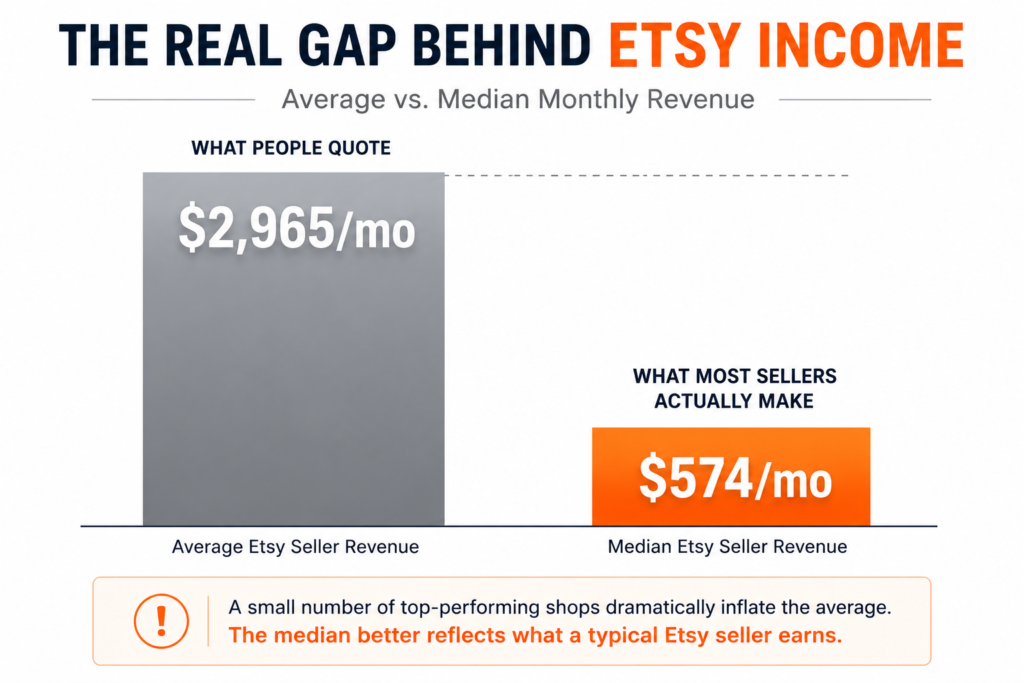
The median Etsy seller brings in $574 a month. Not the $2,965 a month you’ll see quoted as the “average.” Half of all sellers make less than that $574 figure — and almost nobody leads with it.
Why This Article Exists
I’ve now written a whole series about selling digital products on Etsy. How to find a niche. How to price what you make. How to fix a shop that isn’t selling. How to get started without an audience.
All of that advice means very little if I never tell you honestly what the money actually looks like once you do it.
So this is that article. Not the best-case screenshots people post when one template blows up. Not the six-figure outlier stories. The actual distribution of outcomes, broken into tiers, with the data behind each one.
The Short Answer: How Much Can You Make Selling Digital Products on Etsy?
The average Etsy seller earns $2,965 a month in revenue. The median seller earns $574 a month.
That gap is the whole story. A small number of high-performing shops pull the average way up, while a much larger group of sellers earns a modest, often part-time amount of money.
Where you land inside that range comes down to three things: how many listings you have live, how long you’ve been consistently publishing, and whether your products are actually matched to something people are searching for.
None of those three things are luck. All three are explainable. And all three are things you can act on — which is most of the point of this article.
Table of Contents
The Number Everyone Quotes Isn’t the Number That Matters
The biggest surprise in researching this piece wasn’t how much top Etsy sellers make. It was how far the commonly cited “creator economy” number sits from anything resembling a typical Etsy shop.
That $102,000–$136,000 figure comes from a survey of digital creators broadly, not Etsy sellers specifically. It describes an average across a population skewed by people running multi-platform businesses — paid newsletters, sponsorship deals, multiple income streams stacked on top of each other.
Treating it as a benchmark for “what I should expect from an Etsy shop” sets you up to measure your first year against a number that was never describing your situation in the first place.
The Etsy-specific picture looks different. The average seller does earn $2,965 a month. But averages get pulled upward by a small number of large shops — the same way a handful of very high incomes can pull up a city’s “average salary” even though most residents earn far less.
The median is the better measure of what a typical seller actually experiences. And it tells a much more modest story than the average does.
That’s the gap. One number describes a marketing pitch. The other describes a typical shop.
How Long It Actually Takes to Make Money
Ask anyone who’s opened an Etsy shop how long it took to feel “real,” and you’ll rarely hear “immediately.”
The pattern that shows up in the data matches what most sellers will tell you anecdotally. This is slow at the start, for almost everyone.
If you’re brand new, realistic earnings in your first six months land somewhere between $100 and $500 total. Not per month. Total.
If you’re treating it as a part-time project — five to fifteen hours a week — expect something in the $500 to $2,000 a month range, and usually not until six to twelve months of consistent listings in.
Go all-in at forty or more hours a week, and $2,000 to $8,000 a month becomes realistic. But typically not before the twelve-to-twenty-four-month mark.
Full-time income that could replace a job tends to take one to two years of sustained work. Not weeks.
There’s a faster milestone worth separating out from all of this: the first sale. Across digital product shops specifically, the average time to a first sale is around 17 days, though the actual range runs anywhere from 3 days to 112 days.
A first sale is encouraging. But it isn’t a signal that the business has arrived — it’s closer to a signal that the listing works and people can find it.
If you’re starting from absolute zero with no following to lean on, How to Sell Digital Products With No Audience walks through how that first sale tends to happen.
The honest takeaway: nothing about this timeline is broken if month three looks unimpressive. Month three looks unimpressive for almost everyone.
The Five Income Tiers
What struck me most while pulling this data together wasn’t the size of the gap between top and bottom sellers. It was how cleanly the whole seller population sorts into distinct, predictable tiers — almost like a funnel.
| Tier | Monthly Revenue | % of Sellers | Time/Week |
|---|---|---|---|
| Casual | $0–$100 | 65% | 1–3 hrs |
| Side Hustle | $100–$2,000 | 18% | 5–15 hrs |
| Part-Time Business | $2,000–$5,000 | 10% | 15–30 hrs |
| Full-Time Business | $5,000–$20,000 | 5% | 40+ hrs |
| Elite | $20,000–$100,000+ | 2% | Full business |
Sixty-five percent of all sellers — nearly two-thirds — sit in the Casual tier, earning under $100 a month while spending just a few hours a week on their shop. That’s not a small footnote. It’s the majority outcome.
It mostly reflects people who list a handful of products, treat the shop as a side experiment, and don’t return often enough to build momentum. Not people who tried seriously and were rejected by the market.
Eighteen percent land in Side Hustle territory, putting in five to fifteen hours a week for $100 to $2,000 a month. This is where consistency starts to show up. More listings, more time spent on each one, usually a few months of history behind the shop.
Ten percent reach Part-Time Business, between $2,000 and $5,000 a month. Five percent go further into Full-Time territory, $5,000 to $20,000 monthly, putting in a full work week. And right at the top, about 2 percent of sellers reach Elite status — $20,000 to over $100,000 a month, run as a genuine business rather than a side project.
The shape of that funnel is the real takeaway. Most of the drop-off happens early, between Casual and Side Hustle, not between Full-Time and Elite. Getting out of the bottom tier matters more than chasing the top one.
Why Digital Products Change the Math
Something I didn’t fully appreciate before digging into this: the type of product you sell on Etsy changes your economics almost as much as how many hours you put in.
Digital products carry the best margins on the entire platform — typically 70 to 95 percent, since there’s no material cost and nothing to ship. A digital product priced between $8 and $25 nets you $6 to $23 per sale.
Compare that to handmade jewelry, which nets 40 to 70 percent after materials, or print-on-demand items, which often net as little as 15 to 40 percent once production costs come out.
Selling digital products doesn’t guarantee success. But it does mean a much larger share of every sale stays with you.
Planners, checklists, and Canva template types that actually sell are common starting points precisely because the upfront effort is one-time and the margin per sale stays high indefinitely.
Listing count compounds that margin advantage. A separate look at Etsy Shop Manager data found that shops with only one to five digital listings had a median monthly revenue of just $142, while shops with twenty or more listings in a validated niche had a median of $897 a month. More than six times higher.
Average time to a first sale across both groups was the same 17 days mentioned earlier, but the spread was wide — from 3 days to 112 days. More listings means more entry points into Etsy search, not just more inventory sitting in a shop.
What You Actually Keep After Fees and Taxes
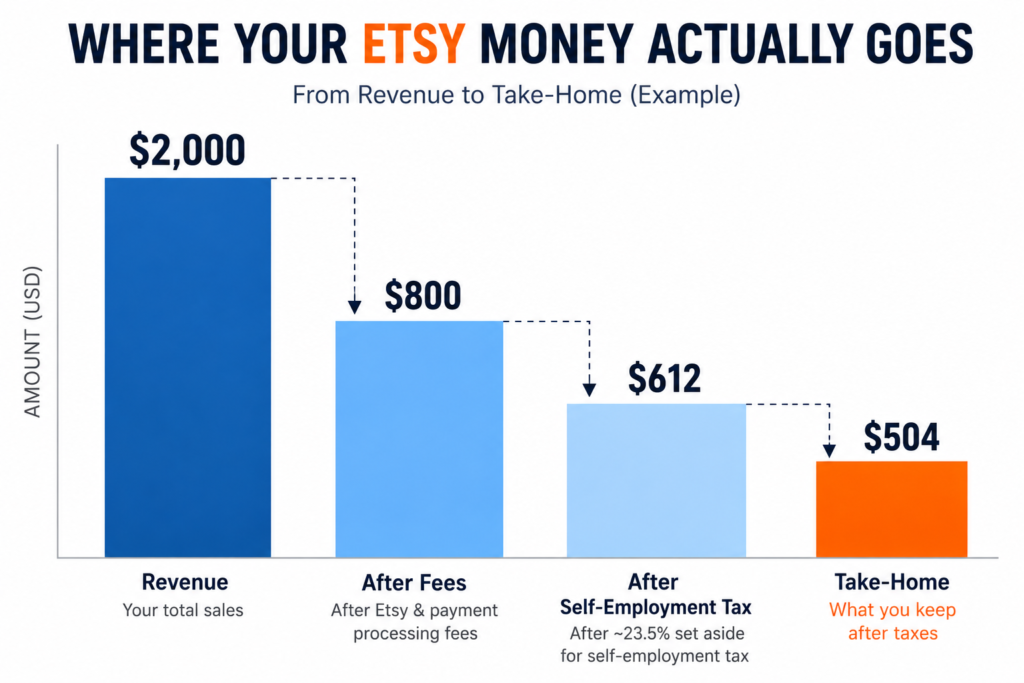
Revenue is the number every income chart shows you. It’s also not the number that lands in your bank account, and almost nothing written about Etsy income walks through that gap directly.
Here’s one example calculation, using U.S. tax rates, purely to illustrate how much fees and taxes can take out of a number that looks bigger on paper.
Take a seller earning $2,000 a month in revenue. After Etsy fees, payment processing, software, ads and the other costs of running a shop, say 40 percent of that is left as profit. That’s $800 a month before tax. After self-employment tax of 15.3 percent and income tax at a 22 percent bracket, take-home in this specific scenario lands closer to $504 a month, roughly 25 percent of the original revenue figure.
Tax rules vary enormously by country, and this example reflects U.S. self-employment tax specifically. Treat it as an illustration of how much distance can exist between “revenue” and “what you keep,” not a number to apply to your own situation.
If you’re outside the U.S., the percentages will be different. But the underlying lesson generally holds: whatever revenue figure you see quoted, your actual take-home will be meaningfully lower.
How to Price Digital Products on Etsy gets into building that cushion into your pricing from the start, rather than discovering it at tax time.
If you want a rule for how much to put aside, how much to set aside for taxes on your side hustle walks through it.
If you ever get there, what to check before a side hustle replaces your job is worth reading first.
What Separates the Top 17%
It would be convenient if the difference between a Casual seller and a Part-Time or Full-Time one came down to luck, timing, or some algorithm preference nobody can control. The data doesn’t really support that story.
The clearest separator is listing count. The bottom 65 percent of sellers run 5 to 20 listings. The middle 18 percent run 20 to 100. The top 17 percent — Part-Time, Full-Time, and Elite combined — run 100 to 500 listings or more.
Each listing functions as its own entry point into Etsy search. A shop with ten listings simply has ten chances to be discovered, while a shop with two hundred has two hundred. That’s not a strategy hack. It’s closer to basic math about surface area in a search-driven marketplace.
This is the same dynamic the Trust ring in Why Your Etsy Shop Isn’t Getting Sales gets into — visibility compounds with volume, not just with quality.
The second separator is whether those listings are actually matched to demand. Publishing more of the wrong product doesn’t move you up a tier. It just produces more listings that don’t convert.
That’s the kind of groundwork I Tried Finding Low-Competition Etsy Niches was built to help with — confirming people are searching for what you’re about to make before you make fifty versions of it.
Why Most Sellers Quit Before Momentum Arrives
Here’s the part of the data that reframed how I think about that 65 percent Casual tier: it’s mostly not a story about the market rejecting people. It’s a story about people leaving before the market had a real chance to respond.
A survey of 1,247 active Etsy digital sellers found that 63 percent abandoned their first product within 90 days.
The reason usually wasn’t a lack of traffic reaching the listing. It was that the listing wasn’t converting once people clicked, often because there was a mismatch between what a buyer searching that term actually wanted and what the listing delivered.
Ninety days is not very long to fix that kind of mismatch, especially while also learning how Etsy search works and building out a catalog at the same time.
That’s a fixable problem, not a verdict on the business model. A shop with five listings and one underperforming product looks a lot like failure from the inside. A shop with thirty listings, refined over a year based on what actually sold, looks completely different.
The data suggests that shift in listing count and patience, more than any single insight or lucky break, is what moves a shop out of the Casual tier.
Frequently Asked Questions
How much does the average Etsy seller actually make?
The average Etsy seller earns about $2,965 a month in revenue, but a small number of top-earning shops pull that number up. The median seller earns about $574 a month in revenue, which is a better picture of a typical shop. Most sellers fall well below the average.
Is it realistic to make a full-time income selling digital products on Etsy?
Yes, but it typically takes one to two years of consistent effort, not weeks or months. Sellers treating it as full-time work, 40 or more hours a week, realistically earn $2,000 to $8,000 a month after 12 to 24 months. Only about 5 percent of all Etsy sellers reach this full-time tier.
How long does it take to make money selling digital products on Etsy?
Average time to a first sale on digital products is around 17 days, though the range spans from 3 to 112 days. Meaningful, consistent income takes considerably longer — 6 to 12 months for part-time sellers, and 12 to 24 months for those treating it as a full-time business.
Why do most Etsy sellers make so little money?
Most sellers earn modest amounts because they list only a handful of products, don’t optimize those listings for what buyers are actually searching for, and stop before reaching the point where momentum builds. A separate survey found that 63 percent of digital sellers abandon their first product within 90 days, often because of mismatched buyer expectations rather than a lack of traffic.
What is a realistic income for a part-time Etsy seller?
A seller putting in five to fifteen hours a week can realistically expect about $500 to $2,000 a month in revenue, usually after six to twelve months of consistent listings. The first six months are often much lower, closer to $100 to $500 in total.
Final Thoughts
Most sellers earn very little because they stop before momentum arrives, publish too few products, or never validate demand. The sellers earning meaningful income are usually the ones who keep improving, keep publishing, and stay in the game long enough for momentum to compound.
None of that requires being one of the 2 percent. It requires treating the first ninety days as the beginning of a listing catalog rather than a verdict on the idea, choosing products you’ve already confirmed people search for — which is exactly what I Tried Finding Low-Competition Etsy Niches was about — and giving the math time to work in your favor instead of judging it after five listings and six weeks.
So — how much can you make selling digital products on Etsy? The real number is $574 a month for a typical seller. That’s not the headline anyone wants. But it’s the honest one, and it’s a far more useful place to start than a number that was never describing you in the first place.
Pingback: How to Write an Etsy Listing for Digital Products
Pingback: Is Selling Digital Products on Etsy Profitable? (2026 Data)
Pingback: How to Budget Side Hustle Income (The Two-Pot System)