Your first year selling on Etsy, you bring in $3,000. It feels like pure win — money you didn’t have before, earned on your own time, on top of a job that already pays the bills. So you spend it. Not recklessly, just normally: some goes to better supplies, some covers a few tight weeks, some goes to things you’d been putting off for a while.
Then tax season arrives, and you owe $700 to $900 you never saw coming. Not because you did anything wrong, and not because your shop underperformed — because nobody told you how much to set aside for taxes for your side hustle before that first payment ever landed. The money already had a season’s worth of decisions made about it, and none of those decisions left room for this one.
One note before we get into the numbers: this is general guidance, not personal tax advice — your situation may vary, and a CPA is always worth it for specifics. But the core number holds for almost everyone: 25-30% of every payment needs to be set aside before it becomes spending money, savings, or anything else.
If you’ve already got your Two-Pot System running, you already know this number — it’s the same one from the tax step in Pot 2’s allocation order, the same one that fills the Tax Reserve lane in your Three-Lane setup. What this article does is finally explain where that number comes from, why it’s higher than most people expect, and what to actually do with it once tax deadlines start arriving. By the end, you won’t just be following a rule — you’ll understand it well enough to stop second-guessing it.
Table of Contents
How Much to Set Aside for Taxes: Why It’s Higher Than People Expect
When you have a full-time job, taxes feel almost automatic. Every paycheck, a chunk disappears before it even reaches you, and your employer quietly handles half of something you’ve probably never had to think about: Social Security and Medicare. It’s built into the system so smoothly that most W-2 employees go their whole working life without learning how it actually functions.
Side hustle income doesn’t get that same courtesy. Nobody withholds anything from an Etsy payment, a freelance invoice, or a client transfer. And sitting inside that gap is a second tax most people have never heard of until it hits them: self-employment tax, a flat 15.3% covering the exact same Social Security and Medicare contributions your employer normally splits with you. Except now there’s no employer to split it with. You’re covering the full amount yourself, both halves.
Here’s the part that catches almost everyone off guard the first time: self-employment tax isn’t instead of income tax. It sits on top of it. You’re not choosing between the two — you owe both, stacked on the same dollar. That stacking is the entire reason 25-30% is the real number, not the 12-15% a lot of people assume based on what disappears from their regular paycheck.
None of this is a penalty for being self-employed. It’s simply what happens once there’s no one else quietly covering half the bill for you anymore.
So Why 25-30%, Specifically?
Once you know both taxes are stacking on top of each other, the 25-30% figure stops being a guess and turns into simple addition.
Self-employment tax is a flat 15.3%, the same for everyone regardless of income level. On top of that sits regular federal income tax, which depends on your total household income — your job and your side hustle combined — and typically lands somewhere in the 10-15% range for most side hustlers in the early stages. Add the two together, and you land right in the 25-30% window people are usually told to set aside, without ever being shown where the number actually came from.
If you’ve been following the Two-Pot System’s allocation order, this is exactly the number the tax step already asks for — 25-30%, no exceptions. It’s the same number that fills your Tax Reserve lane in the Three-Lane setup. None of that guidance was arbitrary. It was built around the real combined tax burden the whole time; you just hadn’t seen the math behind it until now.
The exact percentage does shift a little depending on your situation. If your side hustle income is still small — a few hundred dollars a year — the real math might land you slightly under 25%. If you’re bringing in consistent income on top of a well-paying job, it can creep closer to 30%, sometimes a touch higher depending on your tax bracket. Either way, 25-30% is a safe starting range, and setting aside slightly too much costs you far less than coming up short.
Do You Actually Need to File Taxes for Your Side Hustle?
It’s easy to assume a few hundred dollars from an Etsy shop is too small for the IRS to notice. It isn’t.
Once your net side hustle earnings pass $400 for the year, you have a filing obligation — full stop, regardless of whether you also hold a full-time job. That’s a genuinely low bar. A handful of good sales months, or sometimes even one strong month, can clear it without much effort. A lot of first-year side hustlers assume their W-2 job “already takes care of the taxes,” and it does — but only for the W-2 income. Your side hustle is its own separate stream of income, with its own separate rules, and it doesn’t quietly fold into your employer’s paperwork just because you also happen to have a day job.
None of this is meant to alarm you. It’s meant to remove the guesswork. If your side hustle has brought in more than $400 this year, you already know exactly where you stand — no more wondering whether it’s “too small to count.”
The Quarterly Payment Deadlines
Once you know you owe taxes on side hustle income, the next question is when you actually have to pay it. The IRS doesn’t wait until April — if you expect to owe $1,000 or more for the year from income with no withholding, you’re required to pay in four installments spread across the year, not one lump sum at tax time.
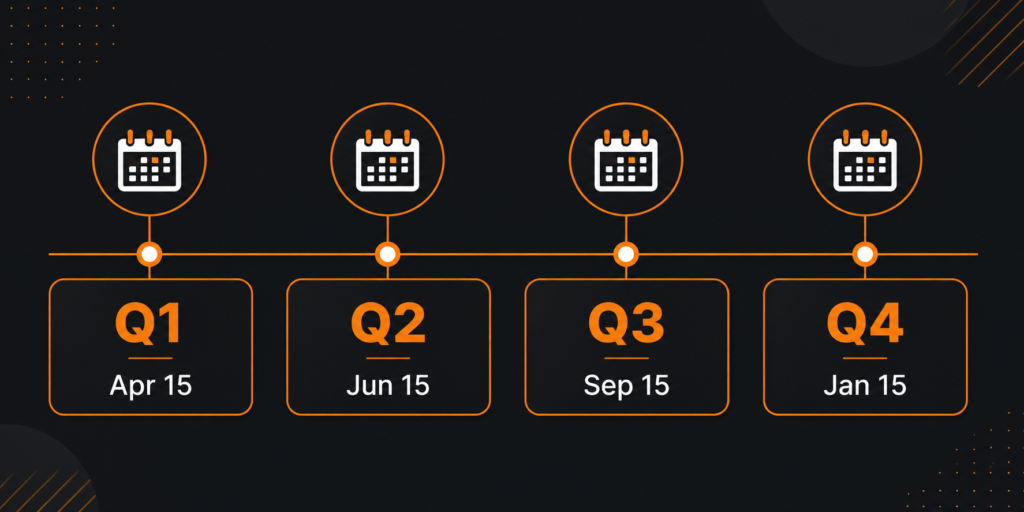
Here are the four deadlines for 2026:
Q1 2026: April 15, 2026 — covers income earned January through March.
Q2 2026: June 15, 2026 — covers income earned April and May, a shorter two-month window.
Q3 2026: September 15, 2026 — covers income earned June through August.
Q4 2026: January 15, 2027 — covers income earned September through December.
All four of these dates land on weekdays in 2026, so none of them shift to a later business day this cycle. Missing one doesn’t erase the obligation — it just means the next payment arrives with a penalty already attached, which is exactly what the next section is built to help you avoid entirely.
The Safe Harbor Rule (The Easiest Way to Never Guess Wrong)
Here’s the part that causes the most anxiety in all of this: what if you don’t actually know what you’ll owe? Side hustle income moves around — a great month, a slow one — and trying to calculate a perfectly accurate quarterly payment every three months can feel like a guessing game with real penalties attached if you get it wrong.
There’s a rule that removes the guessing entirely: safe harbor. Pay 100% of last year’s total tax liability, split evenly across your four quarterly payments, and you owe no underpayment penalty — regardless of what you actually earn or owe this year. If your side hustle has a breakout year and ends up owing significantly more than expected, safe harbor still protects you. You simply settle the difference when you file, with no penalty attached to that gap.
Here’s what that looks like in practice: if your 2025 tax return showed $3,600 in total federal tax, paying $900 each quarter in 2026 satisfies safe harbor completely — even if this year’s side hustle income ends up considerably higher than last year’s. (If your prior-year income was above $150,000, the safe harbor threshold rises slightly to 110% instead of 100% — worth knowing, though it won’t apply to most people just starting out.)
Actually making the payment is simple once you know the number — IRS Direct Pay lets you send each quarterly payment straight from your bank account, free, without creating an account or mailing anything in.
This is really what the entire quarterly system comes down to. Missing a payment without safe harbor protection triggers a penalty around 7-8% annualized, calculated from the exact due date you missed — which is precisely the anxiety safe harbor exists to eliminate. Once your payments are based on last year’s number instead of this year’s guesswork, there’s nothing left to second-guess.
Frequently Asked Questions
What if my side hustle income changes a lot month to month?
That’s exactly what safe harbor solves. Instead of trying to predict an unpredictable number every quarter, you base your payments on last year’s tax liability instead. A slow month or a great month stops mattering for penalty purposes — you’re covered either way.
Do I need to make quarterly payments if my side hustle only made a few hundred dollars?
If you don’t expect to owe $1,000 or more for the year, you’re not required to make quarterly payments — you can simply pay what’s owed when you file. But if your side hustle income is growing, it’s worth checking each quarter rather than assuming you’re still under the threshold.
Can I just increase my W-2 withholding instead of paying quarterly?
Yes — this is a genuinely underused option. The IRS only cares that tax gets paid on time, not through which channel it arrives. If your day job’s paycheck can absorb extra withholding to cover your side hustle’s tax bill, that removes the need for separate quarterly payments entirely.
Should I set aside 25% or 30%?
When figuring out how much to set aside for taxes for your side hustle, start at 30% if you’re unsure. It’s easier to have a small surplus sitting in your Tax Reserve account at filing time than to come up short. Once you’ve filed one full year with side hustle income, you’ll have a much clearer sense of exactly where your own number lands.
How much should I set aside for taxes if I’m self-employed?
The math is the same whether you’re calling it a side hustle or self-employment — you’re on the hook for both self-employment tax (15.3%) and regular income tax, which together usually land in the 25-30% range depending on your bracket. The self-employment tax is the part that catches people off guard, since it doesn’t replace income tax, it stacks on top of it. Setting aside a flat 25-30% of every payment as it comes in, rather than trying to calculate it exactly each time, is the simplest way to stay ahead of it.
Final Thoughts
Three articles, one thread running through all of them — the same answer to how much to set aside for taxes for your side hustle, built from three different angles. The Two-Pot System said taxes come first, 25-30%, no exceptions. The Three-Lane System gave that percentage its own untouchable place to live. This article was always the missing piece — the reason the number is what it is, so you’re not just trusting a rule, you understand it.
That first-year Etsy seller from the beginning of this article — $3,000 earned, all of it spent, a $700-900 bill arriving out of nowhere — doesn’t have to be a story that happens to you. Not because you got lucky, and not because you memorized a percentage. Because you understand exactly where that percentage comes from, exactly when it’s due, and exactly how to protect yourself even in a year you can’t fully predict.
A system you have to remember isn’t a system. Now you don’t just have the system — you know why it works. And the next time a payment lands, you’ll know exactly what it costs before you spend a single dollar of it.
Pingback: How to Budget Side Hustle Income (The Two-Pot System)
Pingback: Why You Need a Separate Bank Account for Your Side Hustle