Your phone buzzes. A payment landed — $180 from an Etsy sale, or your first freelance invoice finally paid. And there it is, that small jolt: it worked. Someone paid you for something you made, on your own time, outside your job. For a second it doesn’t even feel like money. It feels like proof.
Then the money sits in your account. And this is the exact moment that decides everything — not next month, not at tax time, right now. Because side hustle income doesn’t disappear in one dramatic purchase. It disappears quietly, $12 here and $30 there, folded into groceries and gas and a dinner out, until two weeks later you couldn’t tell you it was ever there. You worked for it, it arrived, and then it just… dissolved into normal life.
It happens to almost everyone. Only about 28% of side hustlers actually hold onto what they earn — meaning nearly three out of four watch the money they worked for evaporate into everyday spending. Not because they’re careless. Because nobody ever told them what to do with side hustle income in the narrow window before it drifts.
That window is about ten minutes. This article is what you do inside it — the exact steps, in the exact order, for the moment a payment lands. Do it once and it feels deliberate. Do it a few times and it becomes automatic. Either way, by the end of this, the next payment that hits your account will already know exactly where it’s going.
Table of Contents
Why the First Ten Minutes Decide Everything
The difference between side hustle income that builds something and side hustle income that vanishes isn’t discipline. It’s speed.
Money that sits in your everyday checking account doesn’t stay neutral. It quietly becomes spendable — not because you decide to spend it, but because it’s sitting right there next to the money you already spend on everything else. Your brain stops seeing it as “the $180 I earned from my shop” and starts seeing it as “the balance in my account.” And once it’s just balance, it gets treated like balance. It funds a slightly bigger grocery run, covers a dinner you’d have skipped, absorbs a bill without you noticing. No single choice feels wrong. That’s exactly why it works so well as a disappearing act. It’s not a rare problem, either — Bankrate found that only about 28% of side hustlers actually save what they earn, which means the disappearing act is the norm, not the exception.
Acting fast is what breaks the spell. The moment a payment lands, before it has a chance to blend in, you give each part of it a specific job — and suddenly it’s not “balance” anymore. It’s taxes, and emergency savings, and money aimed at a goal, and yes, some genuinely guilt-free spending. Each dollar has somewhere to be, so none of it drifts.
This is really the entire idea behind the Two-Pot System — keeping your side hustle money separate from the money that runs your everyday life, so the two never blur together. What this article adds is the timing. The Two-Pot System tells you the money needs its own jobs. The first ten minutes are when you actually assign them.
What to Do With Side Hustle Income, Step by Step
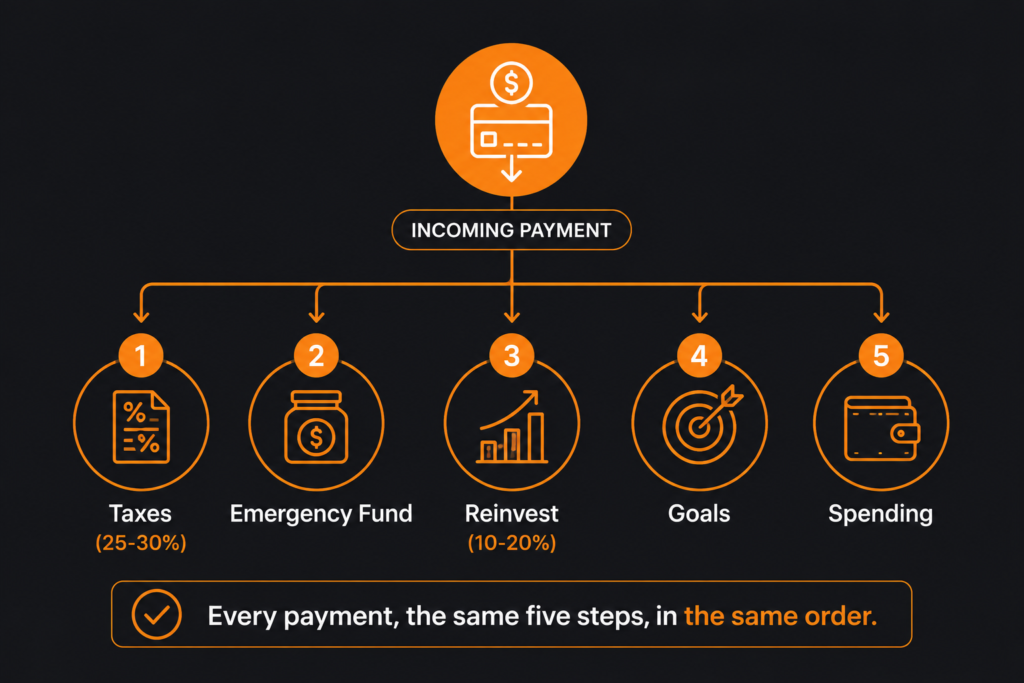
Here’s the whole system in one place. Five steps, same order every time, run the moment a payment lands. You’re not deciding anything in the moment — the order already decided for you. You’re just moving money into the slots it already belongs in.
1. Taxes first. Before anything else, 25-30% comes off the top and moves into your tax account. This isn’t your money — it was never your money — so it’s the first thing to leave. If you want the full reasoning behind that percentage, here’s exactly how much to set aside and why, but the short version is: take it out now, and tax season never becomes a crisis. Moving it into a separate account it can’t leak out of is what makes this stick.
2. Emergency fund second. Until you’ve got 3-6 months of expenses set aside, a slice of every payment goes here. This is the buffer that turns a slow month from a panic into a shrug. Early on, this step matters more than almost anything else you could do with the money.
3. Reinvestment third. Around 10-20% goes back into the hustle itself — supplies, tools, ads, whatever helps it grow. Notice the cap. Reinvesting everything feels productive, but it means your shop grows while your actual life never changes. Keep it bounded on purpose.
4. Goals fourth. What’s next for you — debt gone, a real savings cushion, something you’re actually working toward. This is the money with a destination, and it’s worth its own section further down.
5. Spending last. Whatever’s left is yours, completely and guiltlessly. Not because you snuck it past the system, but because it cleared every other priority first and won anyway. This is real spending money, and it’s supposed to exist.
A Real Example: Walking $180 Through the System
Percentages are easy to nod along to and hard to actually picture. So let’s take a real payment and walk it through, dollar by dollar, the way it’d actually happen the afternoon it lands.
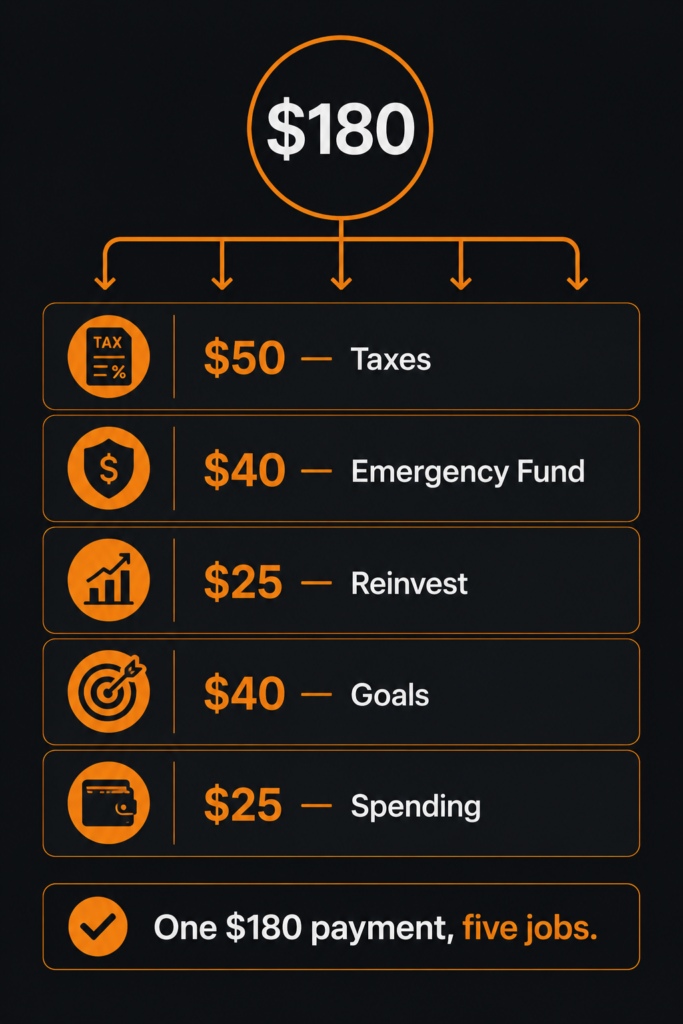
You’ve made a sale. $180 hits your account — a realistic number for a growing Etsy shop, right in the range where a shop starts becoming genuinely profitable. The notification comes in, and instead of letting it sit, you open your banking app and move it through the five steps.
Taxes first — $50 out. You take 28% off the top and send it to your tax account. That’s $50.40, rounded up to $50 to keep it simple. Gone before you’ve really thought about it, because it was never yours. You’re now working with $130.
Emergency fund second — $40 out. It’s not full yet, so this stays a priority. You’re not building a safety net overnight — you’re building it $40 at a time, every payment, until one day it’s just there. Down to $90.
Reinvestment third — $25 out. Back into the shop — materials, or a “shop expenses” pile for later. Capped on purpose: you’re deliberately not dumping all $90 back in, because some of this money is supposed to reach your actual life. $65 left.
Goals fourth — $40 out. Toward whatever you’re saving for — a card you’re paying off, a trip, a nicer laptop. It goes into a named bucket that’s actually moving toward something. $25 left.
Spending last — $25, yours. Completely, guiltlessly yours. No guilt attached, because it cleared every other job first. This is the reward that makes the whole system sustainable instead of punishing.
Look at what happened. That $180 didn’t disappear — it did five jobs, and you still walked away with real money to spend. Taxes handled, safety net grown, shop reinvested, a goal closer, and money to enjoy. Same $180 either way. The only difference is this version still exists tomorrow.
The Goals Step — Giving Your Money Something to Aim At
Of all five steps, the goals step is the one that quietly decides whether this system sticks. The others are protective — taxes, emergency fund, a bounded reinvestment. Necessary, but not exactly exciting. The goals step is the one that gives you a reason to keep doing this at all.
Here’s the problem with “savings” as a concept: it’s shapeless. Money going into a vague savings pile doesn’t feel like progress, it feels like deprivation — money you’re not allowed to spend, sitting somewhere doing nothing you can see. That’s hard to stay motivated for, payment after payment.
The fix is a sinking fund, which is a slightly technical name for a very simple idea: a named bucket for one specific thing. Not “savings” — “new laptop for the shop.” Not “money for later” — “Portugal, next spring.” The moment a goal has a name, every dollar you move toward it feels different. You’re not withholding money from yourself. You’re buying the laptop in installments, funding the trip a little at a time, watching something you actually want get closer with every payment.
You can run several of these at once — one for a bigger piece of equipment, one for a trip, one for a debt you’re killing off. The point isn’t how many. The point is that each one has a name and a finish line, so the money going into it feels like momentum instead of sacrifice.
This is the part of your side hustle income that’s literally building your future — not the abstract, someday kind, but the specific, named, watching-it-happen kind. Your salary handles today. This handles the things today never quite leaves room for.

Making It Automatic (So You Never Have to Decide Again)
Everything so far assumes you’re moving the money by hand — opening the app, doing the split, sending each piece where it goes. That’s the right way to start, because doing it manually a few times is how the order sinks in and starts to feel natural. But it’s not where you want to stay.
The ten-minute routine has one weakness: it still depends on you remembering to do it. Miss a couple of payments, get busy, let a few land without splitting them, and the old drift creeps right back in. The fix is to take yourself out of the loop entirely.
Once your separate accounts are set up, most banks let you automate the transfers between them — so the moment income lands, the tax slice, the emergency fund slice, and the rest route themselves without you lifting a finger. Some people prefer a tool like YNAB, which is built around assigning every dollar a job the instant it arrives, which is exactly what this system is doing anyway. Either way, the goal is the same: turn a ten-minute routine into a zero-minute one.
That’s the real endpoint here. Not you heroically remembering to split every payment through sheer discipline — but a system that does it whether you’re paying attention or not. The best version of this is the one you eventually stop noticing, because it’s just running underneath everything, quietly turning every payment into five jobs while you get on with your day.
Frequently Asked Questions
What if the payment is too small to split five ways?
Split it anyway — the percentages scale down just fine. On a $20 payment, taxes might be $6 and your spending slice might be a couple of dollars, and that’s completely okay. The habit matters more than the amounts early on. A system you run on small payments is a system that’s ready when the big ones start landing.
What if I don’t have all the accounts set up yet?
Start with what you can. If you only have a separate tax account so far, at least do the tax step every time and keep the rest in mind. You don’t need the whole setup perfect before you begin — you just need to stop letting payments land and drift. Build the missing pieces as you go.
Should I pay off debt or build the emergency fund first?
If you’re carrying high-interest debt, like a credit card, it’s usually worth weighting your goals step heavily toward killing that off, since the interest costs you more than a savings account earns. But don’t skip the emergency fund entirely — even a small buffer keeps you from reaching for the credit card again the next time something unexpected hits. A little to both, tilted toward the debt, tends to work.
What if I really want to just spend it this once?
Then spend it — that’s exactly what the fifth step is for. The whole reason guilt-free spending is built into the system is so you never have to fight this impulse. You don’t have to sneak a splurge past your own budget or feel bad about wanting one, because real spending money is already part of the plan. The urge to enjoy what you earned isn’t a weakness to resist. It’s a need the system was designed to meet, every single time, so it never has to blow up the rest. That’s the difference between a system that lasts and one you abandon the first time you want something.
Final Thoughts
Go back to that first moment — the buzz, the notification, the small jolt of it worked. That’s where this started, and it’s worth returning to, because that moment used to be the risky one. The payment lands, and what happens next is either quietly building something or quietly disappearing.
It’s not risky anymore. You know exactly what to do now — the five steps, the order, the ten minutes. And soon not even the ten minutes, once it’s running on its own. The payment that used to dissolve into your grocery budget now splits itself into taxes handled, a safety net growing, a shop reinvested in, a goal moving closer, and money that’s genuinely yours to enjoy. Same payment. Completely different outcome.
That’s the whole point of everything you’ve built across this system: your salary protects your present, and your side hustle builds your future — but only if the money actually survives long enough to do the job. This is what makes it survive.
So the next time your phone buzzes and a payment lands, you won’t have to wonder what to do with it. You’ll already know. And you’ll get to feel that small jolt of it worked without the quiet worry underneath it — because this time, you know the money isn’t going anywhere you didn’t send it.
Pingback: How to Budget Side Hustle Income (The Two-Pot System)