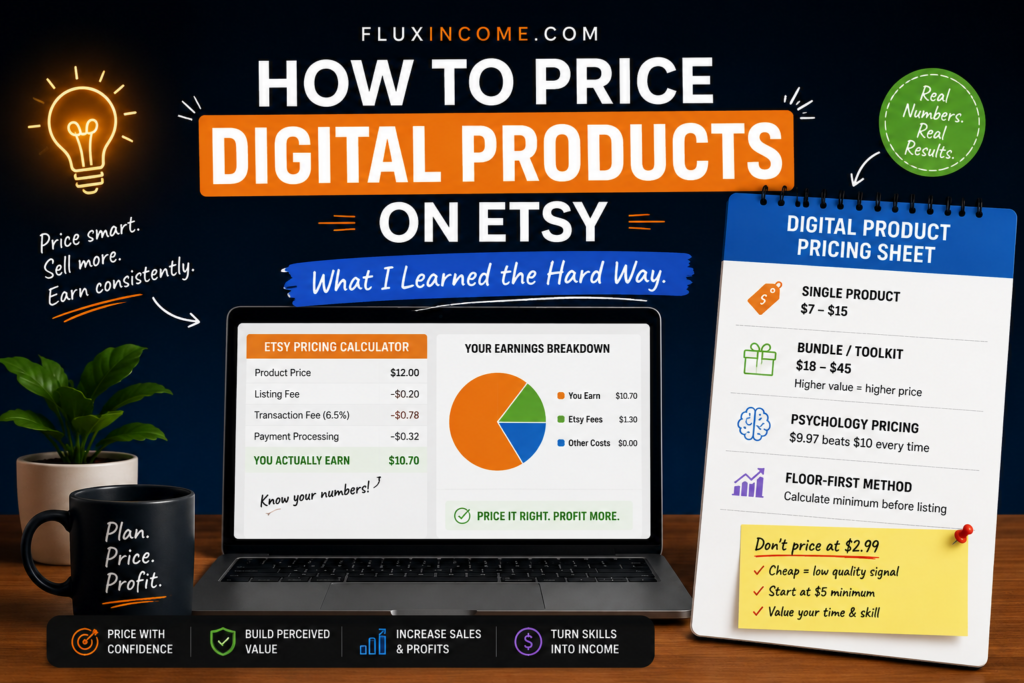
When I created my first digital product, pricing felt like the easiest part of the entire process. At the time, I had no idea how to price digital products on Etsy properly.
The product was finished, the listing was ready, and the thumbnails looked good enough. After spending days creating the actual product, choosing a price felt like a decision I could make in a few minutes.
So that’s exactly what I did.
I searched Etsy, looked at a handful of similar listings, picked a number that seemed reasonable, and hit publish.
At the time, I thought pricing worked the same way as almost everything else. Find out what other people are charging, stay somewhere in the same range, and let the market decide whether your product is worth buying.
What I didn’t realize was that I wasn’t really pricing my product at all.
I was guessing.
The more time I spent reading Etsy seller discussions, studying successful listings, and understanding how fees actually work, the more I realized that pricing is one of the most important decisions you’ll make as a seller.
It doesn’t just affect how much money you earn from a sale.
Pricing influences how buyers perceive quality. It determines how much room you have for future bundles and discounts. In some cases, it can even decide whether your shop becomes profitable or turns into a lot of work for very little return.
If you’re trying to figure out how to price digital products on Etsy, this is the framework I wish I had when I started. It’s simple, practical, and built around the mistakes I see new sellers make over and over again.
Table of Contents
Why Pricing Digital Products Feels So Confusing
Before I settled on a pricing strategy, I spent a surprising amount of time looking for a simple answer.
I thought there would be some kind of standard formula.
Maybe successful Etsy sellers all priced their products the same way.
Maybe there was a universally accepted percentage markup.
Instead, I found the opposite.
Every pricing guide seemed to recommend something different. Some sellers argued that low prices help you get your first sales faster. Others claimed that premium pricing attracts better customers. A few suggested matching competitors, while others said you should ignore competitors completely.
For a beginner, that’s a frustrating place to be.
The challenge is that digital products don’t come with the obvious costs that physical products do. If you’re selling a handmade item, you can calculate material costs, packaging, shipping, and labor. With digital products, most of the work happens upfront.
Once the product is finished, every additional sale feels almost free.
That’s where things get tricky.
Because there isn’t a visible production cost attached to each sale, many new sellers end up choosing prices based on emotion rather than strategy. Some underprice because they’re afraid nobody will buy. Others copy whatever price they see first on Etsy without understanding why that seller chose it.
Before worrying about pricing, it’s important to make sure you’re targeting a niche with real demand. If you’re still deciding what to sell, check out my guide on low-competition Etsy niches that can help you find opportunities with less competition.
I noticed this while browsing template, planner, and spreadsheet listings. Products that looked nearly identical were often priced completely differently. One seller charged $3.99 while another charged $14.99, yet both appeared to be making sales.
At first, that made no sense to me.
The more I researched Etsy pricing, the more I realized that successful sellers weren’t simply charging for the file itself. They were using pricing as a positioning tool. A higher price can signal quality, while a lower price can sometimes make buyers question the value of what they’re getting.
And that’s before Etsy fees enter the picture.
Before deciding what to charge, you need to understand what Etsy actually takes from every sale.
What Etsy Actually Takes From Every Sale
The Etsy Fee Breakdown
One of the biggest mistakes I made early on was assuming the price on my listing was roughly the amount I would earn from a sale.
It sounds obvious now, but when you’re focused on creating products, it’s surprisingly easy to overlook how much Etsy takes behind the scenes.
The reality is that every sale comes with fees, and those fees can have a bigger impact than most beginners expect.
At the time of writing, Etsy charges a $0.20 listing fee for each item you publish. You can always verify the latest rates through Etsy’s official fee structure.
If a sale comes through Etsy’s Offsite Ads program, additional advertising fees may also apply depending on your shop status.
Individually, these fees don’t seem overwhelming.
Together, they can significantly change the amount you actually receive.
That’s why one of the first things I recommend doing is looking beyond the listing price and focusing on your take-home amount instead.
A product priced at $5 and a product priced at $15 don’t just create different revenue numbers. They create very different profit margins once fees are removed.
The goal isn’t to obsess over every cent.
The goal is to understand that pricing decisions should be made with fees in mind from the very beginning.
Once I started thinking that way, pricing became much easier.
What a $10 Sale Really Looks Like
Understanding fees is one thing. Seeing them affect a real sale is another.
Let’s use a simple example.
Imagine you sell a digital product for $10.
At first glance, it feels like a $10 sale.
In reality, Etsy removes several fees before the money reaches your account. The exact amount varies depending on your location, payment processing rates, and whether Offsite Ads are involved, but the principle stays the same.
The number on your listing is not the number you keep.
That’s why experienced sellers tend to think in terms of take-home revenue rather than sale price.
Once I started looking at my products this way, I stopped asking, “What should I charge?”
Instead, I started asking, “How much do I want to keep after fees?”
That small mindset shift completely changed how I approached pricing.
The example below shows how a typical $10 digital product sale can shrink once Etsy’s fees are applied. The exact numbers will vary, but the lesson remains the same: pricing decisions should be based on what you keep, not what you charge.
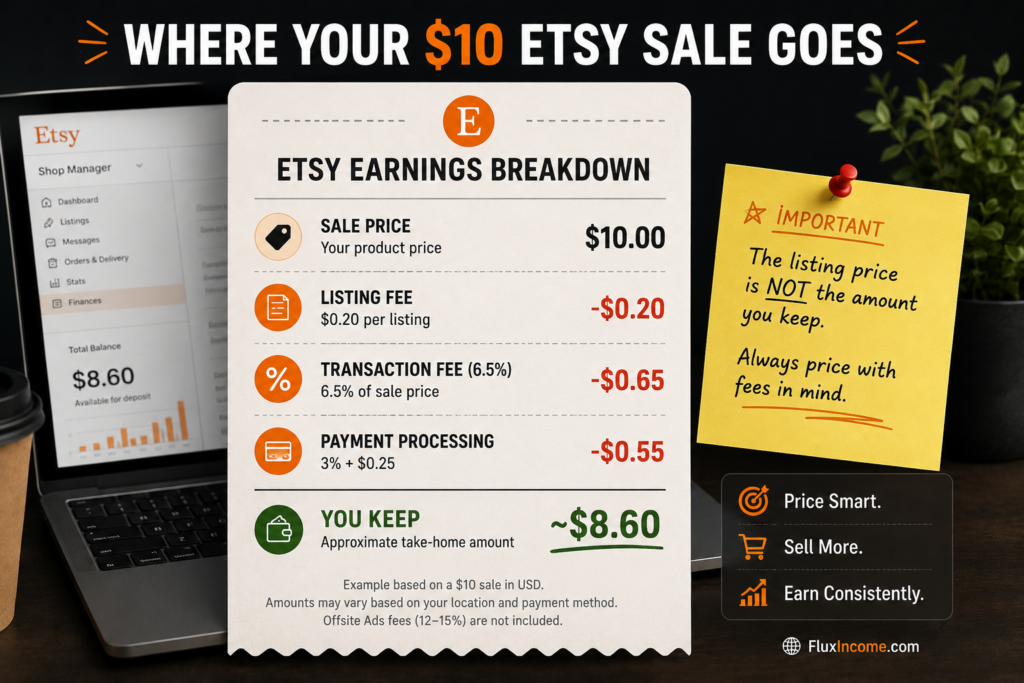
The exact numbers will vary depending on your country, payment processing rates, and whether Offsite Ads are involved. The important takeaway is that the price on your listing is never the amount you actually keep. Understanding that difference is what separates strategic pricing from guessing.
How to Price Digital Products on Etsy Using the Floor-First Pricing Method
At this point, you might be wondering what a good Etsy price actually looks like.
The honest answer is that there isn’t a single number that works for every product.
A budget spreadsheet, a wedding planner, and a Canva template bundle all solve different problems, serve different audiences, and create different levels of value. Trying to price them all using the same rule doesn’t make much sense.
What helped me most was stopping the search for the “perfect” price and focusing on a simple framework instead.
I call it the Floor-First Pricing Method.
The idea is straightforward: before looking at competitors or testing different price points, you need to know the lowest price that still makes sense for your business. From there, you can compare your product to the market and leave room for future growth.
Here’s how it works.
Step 1: Calculate Your Floor Price
Your floor price is the lowest amount you’re willing to charge before fees start making the product unattractive to sell.
Most new Etsy sellers work backwards.
They see someone selling a template for $3.99 and immediately assume they need to charge something similar.
I used to think the same way.
The problem is that competitor pricing doesn’t tell you anything about their goals, costs, experience, or profit margins. Some sellers are testing new products. Others are running promotions. A few may simply be underpricing their work.
Instead of starting with competitors, start with yourself.
Ask a simple question:
“If this product sells 100 times, what price would make me feel like the effort was worth it?”
You don’t need a complicated spreadsheet to answer that. The goal isn’t perfect math. The goal is identifying a minimum price that respects the time and effort you invested in creating the product.
Once you know that number, you have a foundation to build on.
Without it, you’re just reacting to whatever prices happen to be on Etsy today.
Step 2: Research the Market the Right Way
Once you know your floor price, it’s time to look at the market.
This is where many sellers make another common mistake.
They search Etsy, sort through a few listings, find the cheapest option, and try to undercut it.
That strategy rarely ends well.
The cheapest listing on Etsy isn’t necessarily the best listing. In many cases, it isn’t even the most successful listing.
Instead, focus on the products buyers are already choosing.
Search for products similar to yours and pay close attention to Best Seller badges, review counts, and overall presentation. The Etsy Seller Handbook also contains useful guidance on product positioning, customer behavior, and improving your listings over time. For example, Canva templates are one of the easiest digital products to research because successful listings often reveal clear patterns in pricing, design quality, and positioning. I break down several examples in my guide to Canva templates that sell on Etsy. Look at what successful shops charge and compare those prices to the value they’re offering.
You’ll often discover something surprising.
The listings generating the most sales are rarely the cheapest.
Many successful sellers charge more because they’ve built stronger products, bundled additional resources, improved their branding, or simply positioned their offer more effectively.
Pricing isn’t a race to the bottom.
It’s a reflection of perceived value.
The goal isn’t to beat competitors on price. The goal is to understand where your product fits within the market and price accordingly.
Step 3: Price for Bundles From Day One
This was one of the most valuable lessons I learned while researching Etsy pricing.
Even if you’re selling a single product today, think about where your shop will be six months from now.
Many of Etsy’s most successful digital sellers don’t rely on individual products alone. They create collections, bundles, and complete toolkits that solve larger problems.
That’s why it’s important to leave room for growth.
Imagine you launch a budgeting spreadsheet for $9.99.
Later, you create a debt tracker, savings planner, and monthly finance dashboard. Suddenly you have the ingredients for a premium bundle that delivers far more value than any single product.
If you start too low, building those bundles becomes harder.
If you price strategically from the beginning, expanding your product line feels natural.
That’s one reason I prefer thinking about pricing as part of a long-term business rather than a single sale.
A good price shouldn’t just support today’s product.
It should support tomorrow’s opportunities as well.
The Floor-First Pricing Method won’t guarantee the perfect price on your first attempt. No framework can do that. What it does provide is a logical starting point. Instead of guessing, you’ll have a process you can adjust over time as you learn more about your audience and your market.
The next question is obvious: what prices actually seem to work on Etsy today?
Real Etsy Pricing Ranges for Digital Products
One of the first things I wanted when researching Etsy pricing was a simple list of numbers.
Just tell me what people charge.
The problem is that pricing ranges only become useful once you understand the strategy behind them.
A budgeting spreadsheet that saves someone hours every month can often command a higher price than a generic planner. A bundle of templates usually creates more perceived value than a single download. And products aimed at business owners often support higher price points than products designed for casual use.
Still, having a rough benchmark is helpful.
After reviewing successful Etsy listings, seller discussions, and common digital product categories, these are the pricing ranges I saw most often.
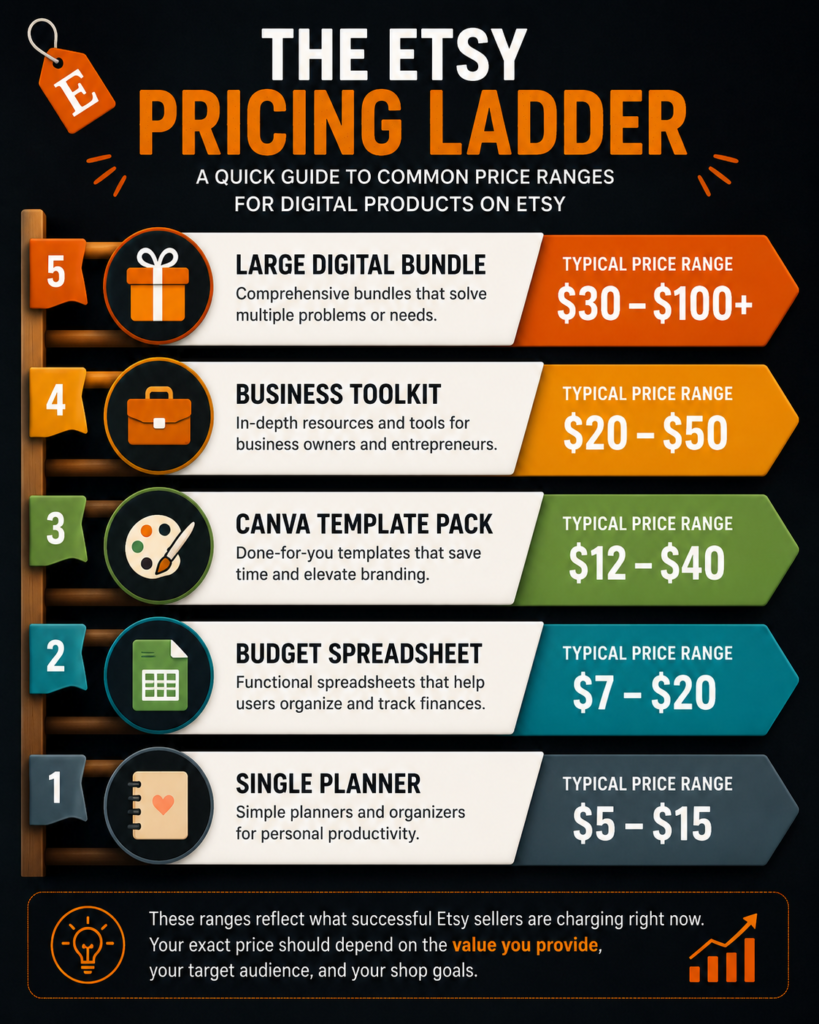
Notice that these ranges overlap.
That’s because buyers aren’t paying for file size or page count. They’re paying for the result the product helps them achieve.
A well-designed budgeting spreadsheet that solves a real problem can justify a higher price than a larger product that offers little practical value.
That’s why I wouldn’t use this table as a pricing rule.
I’d use it as a reality check.
If you’re charging far below these ranges, you may be undervaluing your work. If you’re pricing significantly above them, make sure your product offers enough value to justify the difference.
What I’d Charge If I Were Starting Today
Looking back, one of my biggest mistakes would have been assuming that lower prices automatically lead to more sales.
Today, if I were starting from scratch, I’d focus less on being the cheapest option and more on creating a product that feels worth the price.
For example, here’s how I’d think about pricing a few common digital products.
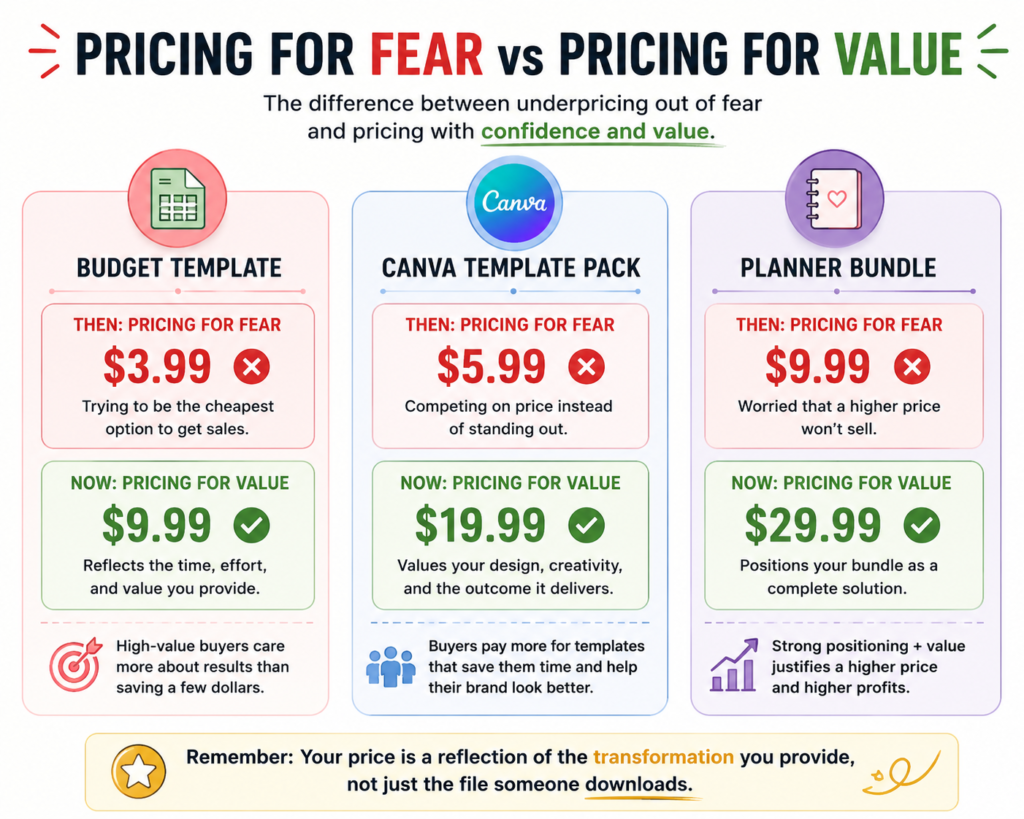
That doesn’t mean these prices are automatically correct.
The point is that I now understand the difference between pricing for fear and pricing for value.
Most beginners underprice because they’re worried nobody will buy.
Many successful sellers charge more because they’ve learned that the right buyers care far more about results than saving a few dollars.
Looking at those pricing examples, one pattern becomes clear.
The sellers who struggle the most aren’t usually overpricing their products.
They’re underpricing them.
And that leads to one of the most common mistakes new Etsy sellers make.
The Biggest Pricing Mistake New Etsy Sellers Make
If I had to summarize the biggest pricing mistake in one sentence, it would be this:
Trying to win on price.
It’s incredibly tempting when you’re new.
You spend hours creating a product, publish your listing, and then look at dozens of competitors already established in the market. Lowering your price feels like the easiest way to stand out.
That’s exactly why so many sellers fall into what I call the $2.99 trap.
The logic sounds reasonable.
If someone is selling a planner for $9.99, surely selling a similar product for $2.99 should attract more buyers.
Unfortunately, pricing doesn’t always work that way.
Buyers don’t automatically assume a lower-priced product is a better deal. In many cases, they assume it’s lower quality. When multiple products appear similar, pricing becomes part of how customers judge value.
A product priced at $2.99 can sometimes create more doubt than confidence.
That’s especially true for digital products, where buyers can’t physically inspect what they’re purchasing.
Instead of asking, “How can I be the cheapest option?”
A better question is:
“How can I become the most valuable option within my price range?”
That mindset shift changes everything.
You stop competing on price alone and start focusing on product quality, branding, customer experience, and the results your product delivers.
Cheap Pricing vs Strategic Pricing
| Cheap Pricing | Strategic Pricing |
| Competes on price | Competes on value |
| Lower profit margins | Higher profit potential |
| Attracts bargain hunters | Attracts committed buyers |
| Difficult to scale | Easier to grow long-term |
| Encourages price wars | Encourages differentiation |
The goal isn’t to charge the highest price in your niche.
It’s to charge a price that reflects the value you provide while leaving enough margin to grow your business over time.
That’s a much more sustainable strategy than constantly competing to be the cheapest seller on Etsy.
Should You Raise Your Prices If You’re Already Selling?
One of the most common questions Etsy sellers ask is whether they should increase their prices after they start getting sales.
In many cases, the answer is yes.
But not immediately and not without a reason.
If your products are consistently selling, your reviews are positive, and customers seem satisfied with what they’re receiving, those are all signs that your pricing may have room to grow.
Many sellers make the mistake of assuming that every sale confirms their current price is perfect.
Sometimes it simply means demand is stronger than expected.
A small price increase can help you improve profit margins without significantly affecting conversion rates.
That doesn’t mean you should double your prices overnight.
Think in terms of gradual testing.
For example, if you’re selling a template for $9.99, consider testing $11.99 or $12.99 and monitoring the results. If sales remain consistent, you’ve increased your revenue without creating additional work.
The key is to pay attention to data rather than emotion.
Don’t keep prices low because you’re afraid buyers will disappear.
And don’t raise prices simply because competitors charge more.
Use actual customer behavior to guide your decisions.
If demand remains strong after a modest increase, that’s often a sign that buyers see enough value in your product to justify the higher price.
Over time, strategic price adjustments can have a much bigger impact on your income than constantly creating new products.
Sometimes earning more isn’t about selling more.
It’s about pricing better.
By now, you probably have a much clearer idea of how Etsy pricing works.
Before wrapping up, let’s quickly answer a few common questions that come up again and again.
Frequently Asked Questions
How much should I charge for digital products on Etsy?
There isn’t a single price that works for every product. A good starting point is to calculate your minimum acceptable price, research successful competitors, and leave room for future bundles. Most digital products on Etsy fall somewhere between $5 and $50, depending on the value they provide.
Is $2.99 too cheap for Etsy digital products?
Not always, but many new sellers underprice their products at $2.99 because they’re afraid higher prices won’t sell. In some cases, extremely low prices can reduce perceived value and leave very little profit after Etsy fees. Focus on value rather than trying to be the cheapest option.
How much does Etsy take from a digital sale?
Etsy charges a listing fee, transaction fee, and payment processing fee on most sales. The exact amount varies based on your location and payment method, but the price on your listing is always higher than the amount you actually receive.
Should I price higher than my competitors?
Not necessarily. Instead of focusing on being higher or lower, focus on matching your price to the value you provide. Many successful Etsy sellers charge more because they offer better products, stronger branding, or additional resources that justify the difference.
Do digital product bundles sell better on Etsy?
Bundles often create more perceived value because buyers receive multiple related resources in a single purchase. While results vary by niche, bundles can increase average order value and make your products easier to position as complete solutions rather than individual downloads.
Final Thoughts
When I first started thinking about Etsy pricing, I assumed the goal was to find the perfect number.
The more I researched, the more I realized that successful sellers approach pricing differently.
They don’t obsess over finding a magic price point.
They focus on value.
A good price should cover your costs, reflect the effort you’ve invested, and leave room for your business to grow. That’s why I prefer the Floor-First Pricing Method. It provides a practical starting point while giving you the flexibility to adjust as you learn more about your audience.
If there’s one lesson I hope you take away from this article, it’s this:
Pricing isn’t just a number.
It’s a positioning decision.
The sooner you stop competing on price alone and start thinking about value, the easier it becomes to build a profitable Etsy shop.
Pingback: Why Is My Etsy Shop Not Getting Sales? 5 Problems Most Sellers Miss
Pingback: How to Write an Etsy Listing for Digital Products