Is selling digital products on Etsy profitable — or is it just another overhyped side hustle?
You have probably seen both sides of this argument.
On one side: screenshots of sellers making $10,000 a month from Canva templates. Six-figure income claims. Stories about quitting full-time jobs to sell printables.
On the other side: “Etsy is saturated.” “The fees are too high.” “It used to work but not anymore.”
Both of these things are true. For someone.
The six-figure sellers exist. The people who tried it, got nowhere, and gave up also exist. Neither story is made up. But neither one is useful if you are trying to decide whether this is worth your time.
The question is not whether Etsy is profitable in general. The question is whether it is profitable for someone who approaches it a specific way — with realistic expectations, a real plan, and enough time to let it work. When I started digging into the data, I realized almost every article was answering the wrong question.
That is what this article answers: is selling digital products on Etsy profitable, and for whom?
The short answer: it can be, for sellers who research demand first and give it time. Digital products keep most of each sale after Etsy’s fees, and a consistent part-time seller can realistically reach $500 to $2,000 a month in revenue after 6 to 12 months. The typical seller earns less than that, which is why the details matter.
But before we get into numbers, there is one thing worth settling first: what does profitable actually mean to you?
Table of Contents
What “Profitable” Actually Means Here
This sounds like an obvious question. It is not.
Some readers would consider $300 a month from Etsy a genuine win — it covers a bill, funds a savings goal, or replaces a part-time shift they would rather not work. For them, profitable is a low bar and Etsy clears it easily.
Other readers need $3,000 a month or more before something feels worth their time. They are looking to replace income, not supplement it. For them, profitable is a much higher bar — and the timeline to reach it is significantly longer.
Neither definition is wrong. But the answer to “is selling digital products on Etsy profitable” is completely different depending on which reader is asking.
Throughout this article, when the data points to realistic earnings for a consistent part-time seller, that means somewhere in the $500 to $2,000 a month range after 6 to 12 months of sustained effort. Full-time income replacement — $3,000 to $5,000 a month — is real but takes longer. Usually 12 to 24 months.
Keep your own definition in mind as you read. It will make the rest of this much easier to evaluate.
Is Etsy Still a Viable Platform?
This is usually the first concern people raise. Etsy is dying. The fees keep going up. It is too competitive now. You missed the window.
These concerns are not invented. Etsy did raise its transaction fee from 5% to 6.5% in 2022 and sellers were angry about it. Competition in certain categories — generic wall art, basic print-on-demand products, unbranded stickers — is brutal. If you are entering those categories, the concern is valid.
But here is what the broader picture actually shows.
According to Etsy’s own investor reports, the Etsy marketplace had 86.5 million active buyers at the end of 2025, roughly double its 2019 level, though down 3.4% from a year earlier. The platform is not booming, but it is still a very large marketplace.
Digital products specifically are a popular category on the platform. Planners, templates, spreadsheets and printables are among the things buyers search for. Demand is there, but it’s spread across a lot of sellers.
The saturation problem is real, but it is specific. Generic products in broad categories face heavy competition. A generic budget planner competes with thousands of other budget planners. A budget planner designed specifically for freelancers with irregular income competes with almost nobody.
That distinction — generic vs niched — is what separates the sellers who feel like Etsy is impossible from the sellers who are quietly building consistent income in categories nobody else thought to target.
So is Etsy still viable? Yes. The platform is not the problem. What you sell and how specifically you target a buyer is what determines whether it works.
What the Income Data Actually Shows
Here is where most articles either oversell the opportunity or bury the reality.
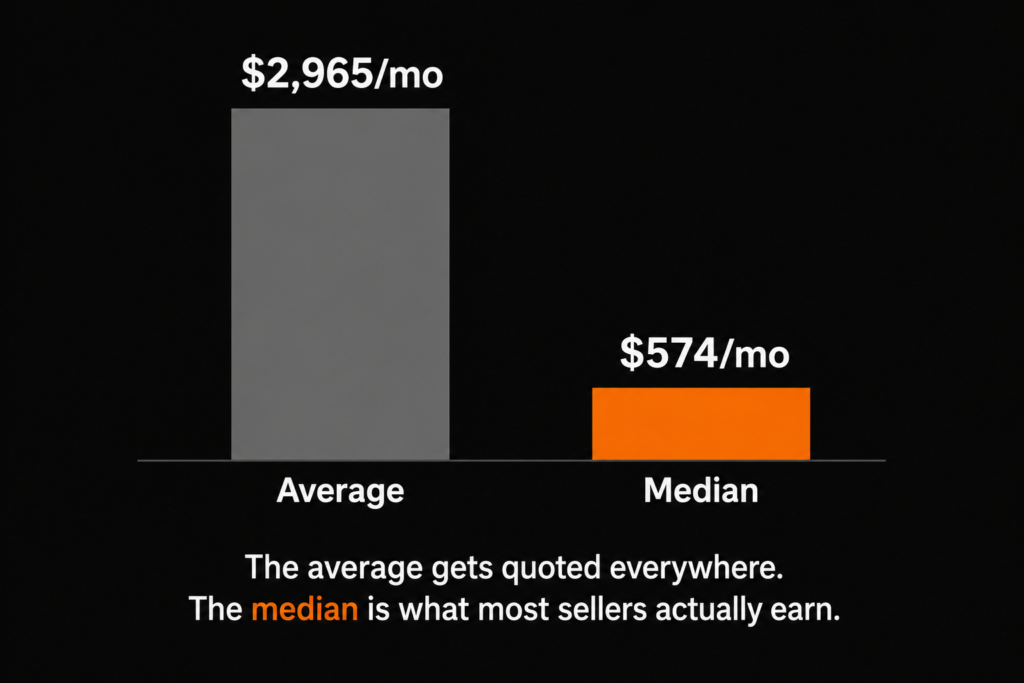
Third-party analyses of Etsy shop data put the average seller at about $2,965 a month in revenue. That number gets quoted everywhere. It’s also misleading, because a small number of very high-earning shops pull the average up significantly, the same way a few billionaires can raise the “average wealth” of an entire city.
The median is the more honest number. Half of all Etsy sellers earn less than about $574 a month in revenue, according to those same analyses. That is the typical outcome, not the exception.
Before that discourages you, here is what else the picture suggests: many sellers in the lower tiers got there because of how they approached it, not because the platform failed them. They listed a handful of products, checked back in a few weeks, and moved on before anything had a real chance to work.
The sellers earning $500 to $2,000 a month consistently are doing something different. More listings. More time in market. Products matched to what buyers are actually searching for.
The full income breakdown — what each tier of seller is doing differently and what separates them — is covered in detail in How Much Can You Make Selling Digital Products on Etsy. The short version: profitability on Etsy is real, but it is determined almost entirely by the approach, not the platform.
Are the Fees Actually Too High?
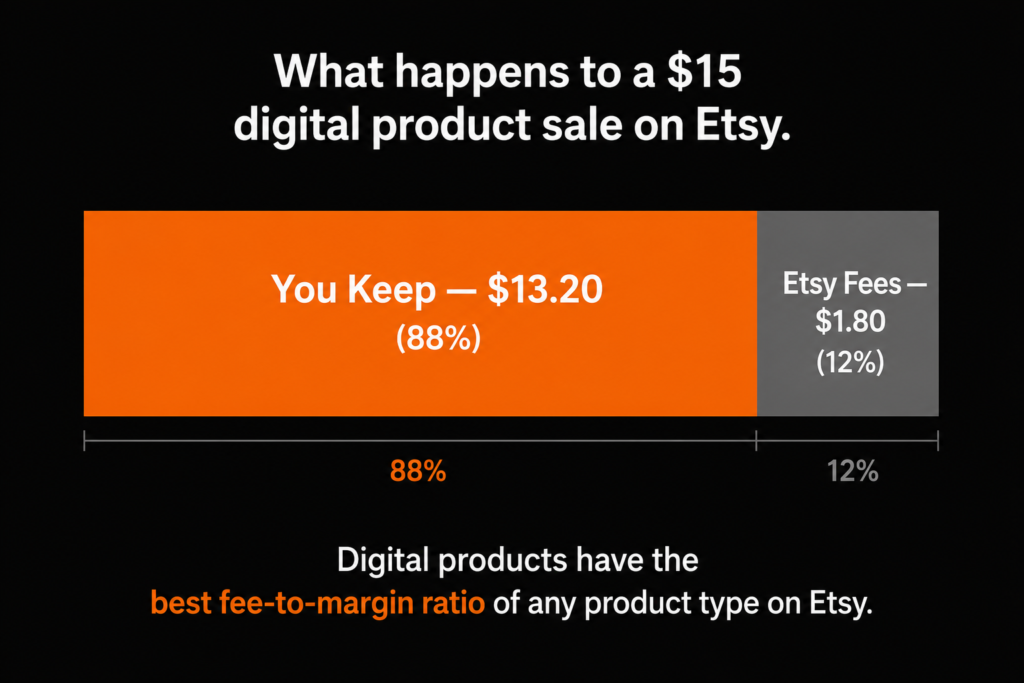
A listing fee of $0.20, charged when you publish a listing and again each time it sells. A transaction fee of 6.5% of the sale price. A payment processing fee of 3% plus $0.25 per order in the U.S.
Combined, that is about 9.5% of the sale price plus $0.45 in flat fees.
On a $15 digital product, that works out to roughly $1.88 in fees. You keep about $13.12, an 87% margin before tax and your own costs.
There is one more fee that changes the picture. If a sale comes from an Etsy ad placed off the platform, Etsy takes an extra 15% of the order for smaller shops, or 12% once a shop passes $10,000 a year in sales, and it becomes mandatory at that point. On that same $15 product, an extra 15% is $2.25, which drops your margin to about 72%. Check Etsy’s current fee page for the exact rates before you price anything.
Now compare that to the alternatives. Handmade physical products typically net 40 to 70% after material costs. Print-on-demand products often net 15 to 40% after production costs. Selling through your own website avoids Etsy fees but you pay payment processing fees anyway and have to drive all your own traffic from scratch.
For digital products specifically, the fee picture is actually quite favorable. There are no material costs. No shipping costs. No production costs. Every sale is nearly pure margin minus Etsy’s cut.
Are the fees real? Yes. Are they too high for digital products? Not for most sellers, when you factor in that Etsy brings millions of buyers to the marketplace and handles all payment processing, dispute resolution, and buyer trust on your behalf. They just are not negligible.
The key is building fees into your pricing from the start rather than discovering them at the end. How to Price Digital Products on Etsy covers exactly how to do that.
The Realistic Timeline (Month by Month)
This is the part most articles skip entirely. They tell you what is possible but not what the journey actually looks like getting there.
Month 1: You open the shop, publish your first few listings, and wait. Very little happens. Impressions are low. Sales are zero or close to it. From the inside it feels like something is broken — like Etsy is not showing your listings to anyone. It is not broken. New listings with no purchase history start with a low quality score and get shown to very few people. This is normal. Almost everyone goes through it.
Month 3: Many digital product sellers see a first sale within the first few weeks, so if you are still here at month three, you have probably seen at least one sale. But consistent sales are not there yet. The sellers who are still going at this point are almost always the ones who kept adding listings rather than waiting for one listing to do all the work.
Month 6: This is where things start to shift for sellers who stayed consistent. Shops with 20 or more listings in a validated niche tend to see more consistent traffic by this point. The gap is not talent or luck. It is listing count and time in market.
Month 12: Sellers who made it through the first year without quitting are almost always in a completely different position than where they started. Part-time income in the $500 to $2,000 a month range is realistic for this group. Some are earning more. The ones earning less are usually still building their catalog.
The honest pattern behind all of this: many sellers drop their first product within the first few months. Most of them did not fail. They left before the market had time to respond.
That is the real timeline risk — not the platform, not the competition, not the fees. It is quitting in month two of a twelve month game.
If the timeline feels long, driving outside traffic is one of the few ways to accelerate it — external buyers who purchase from your listing help Etsy understand faster that the listing is worth showing to more people.
How Does Etsy Compare to Other Options?
Most people asking whether Etsy is profitable are not evaluating it in isolation. They are comparing it — consciously or not — to other ways of making money online.
Here is the honest comparison.
Freelancing gets you income faster — sometimes within days of starting. But it trades time directly for money. When you stop working, the income stops. There is no catalog that keeps earning while you sleep.
Print-on-demand has a similar setup to digital products but with worse margins. After production costs, most POD sellers net 15 to 40% per sale compared to 70 to 90% for digital product sellers. And the most popular POD categories are significantly more saturated than niched digital products.
Blogging has a similar timeline to Etsy — 6 to 18 months before meaningful income arrives — and the early phase is often slow. The income ceiling is higher for established blogs.
Selling through your own website gives you more control and no platform fees, but you start with zero built-in audience. Every visitor has to be earned from scratch through SEO, social media, or ads. Etsy’s 93.5 million active buyers are the reason most digital product sellers start there rather than on their own site.
None of these are bad options. But for someone with a digital skill — design, writing, spreadsheets, teaching — and the patience to build over 6 to 12 months, Etsy sits in a specific position: faster than blogging, better margins than POD, more passive than freelancing, and with a built-in audience that your own website lacks.
What Actually Separates Profitable Shops From Everyone Else
It is not talent. It is not luck. It is not finding some secret product nobody else has thought of.
The sellers who build profitable Etsy shops almost always have two things in common: they confirmed demand existed before they started creating, and they gave it enough time to compound.
That is it. Those two things explain most of the gap between sellers who stay under $100 a month and the sellers earning consistent part-time or full-time income.
Confirming demand means knowing what buyers are actually searching for before you spend time making something. Not guessing. Not creating what you think is a good idea and hoping someone searches for it. Actually checking. Finding low competition Etsy niches is where that process starts — identifying what buyers want that the market is not yet serving well.
Giving it time means staying past the point where most sellers quit. Month two looks the same for almost everyone — slow, discouraging, unclear. The sellers who build something real are the ones who treated month two as the beginning of the catalog, not as a verdict on the idea.
Everything else — listing optimization, traffic strategy, pricing — matters, but it matters less than these two. A well-optimized listing for a product nobody is searching for will not sell. A poorly optimized listing for a product buyers are actively looking for will sell despite the imperfect setup.
Once demand is confirmed and the catalog is building, writing listings that do all three jobs — getting found, getting clicked, and convincing the buyer to purchase — is what turns traffic into consistent revenue.
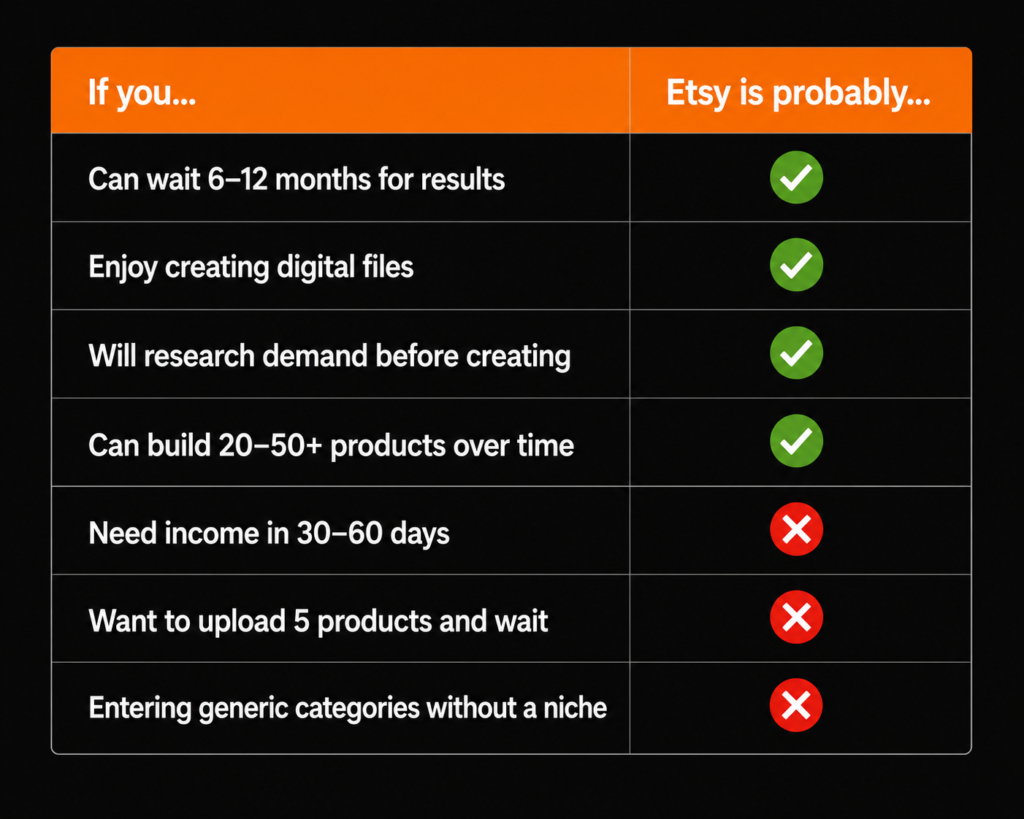
Here is a simple way to figure out which side of this you are on:
| If you… | Etsy is probably… |
|---|---|
| Can wait 6–12 months for meaningful results | A good fit |
| Enjoy creating digital files (templates, planners, spreadsheets) | A good fit |
| Willing to research what buyers search for before creating | A good fit |
| Comfortable publishing 20–50+ products over 6–12 months | A good fit |
| Need income within the next 30–60 days | Not the right fit right now |
| Want to upload 5 products and see what happens | Not the right fit right now |
| Planning to enter a generic category without a specific angle | Not the right fit right now |
Frequently Asked Questions
Is selling digital products on Etsy still worth it in 2026?
It depends on what you are comparing it to and what you need from it. Etsy still has about 86.5 million active buyers, and digital products are a popular category on the platform. The opportunity is real. But the timeline is longer than most people expect, and the sellers who succeed are the ones who treat it like a business rather than a passive income experiment. If you can wait 6 to 12 months and are willing to build a real catalog, the odds are in your favor. If you need income in 30 to 60 days, this is not the right vehicle right now.
How much do Etsy digital product sellers actually make?
The median Etsy seller earns around $574 a month in revenue, according to third-party analyses — not the $2,965 average most articles quote. That average is pulled up by a small number of high-earning shops. The realistic range for a part-time seller who is consistent over 6 to 12 months is $500 to $2,000 a month. Full-time income takes longer — typically 12 to 24 months of sustained effort. The full income breakdown by seller tier is covered in the dedicated income article linked above.
Are Etsy fees too high for digital products?
Not for most digital sellers, but they are real. Etsy takes about 9.5% of each sale plus $0.45 in flat fees, which leaves roughly 87% of a $15 product before tax. If a sale comes from an Etsy ad off the platform, an extra 15% (12% for larger shops) comes off, which can bring the margin closer to 72%. Build the fees into your pricing from the start and they are manageable.
Is Etsy too saturated for digital products?
Saturated in generic categories, yes. A generic budget planner or a generic Canva social media template faces hundreds or thousands of competitors. But a budget planner designed specifically for freelancers with irregular income, or a template pack built for a specific industry, faces almost no direct competition. The saturation argument is real for sellers who enter broad categories without differentiation. It is largely a non-issue for sellers who niche down before they start creating.
What is the profit margin on Etsy digital products?
Digital products usually keep a high margin because there are no material or shipping costs. After Etsy’s standard fees, a $15 product keeps roughly 87% of the sale price before tax. That drops to around 72% when a sale comes from an Etsy ad. Your own software and tool costs come out after that.
Final Thoughts
The six-figure success stories are real. The “Etsy is saturated and not worth it” warnings are also real. Both exist. Neither describes the typical outcome.
The typical outcome for someone who researches demand before creating, builds a catalog of 20 to 50 products over 6 to 12 months, and optimizes their listings is somewhere in the $500 to $2,000 a month range for part-time effort. Not passive. Not overnight. But real, consistent income from products that keep selling without you actively working every hour they earn.
Whether that is worth it depends entirely on what you were looking for when you started reading this.
If you need income in 30 days, Etsy is not the answer right now. If you can treat the first 6 months as building something rather than waiting for something, the odds shift meaningfully in your favor.
The platform is not the variable. The approach is.
That is the honest answer. Everything else — the niche research, the listing optimization, the traffic strategy — is just the work that makes the approach real.
Pingback: What to Do With Side Hustle Income: Your First Paycheck
Pingback: How to Budget Side Hustle Income (The Two-Pot System)
Pingback: How to Track Side Hustle Income and Expenses (No Accountant)