How to get more traffic to your Etsy shop without paid ads — most sellers think the answer is just better SEO.
Fix the titles. Improve the tags. Optimize the listings. Wait for Etsy search to kick in.
That is not wrong. But it is incomplete.
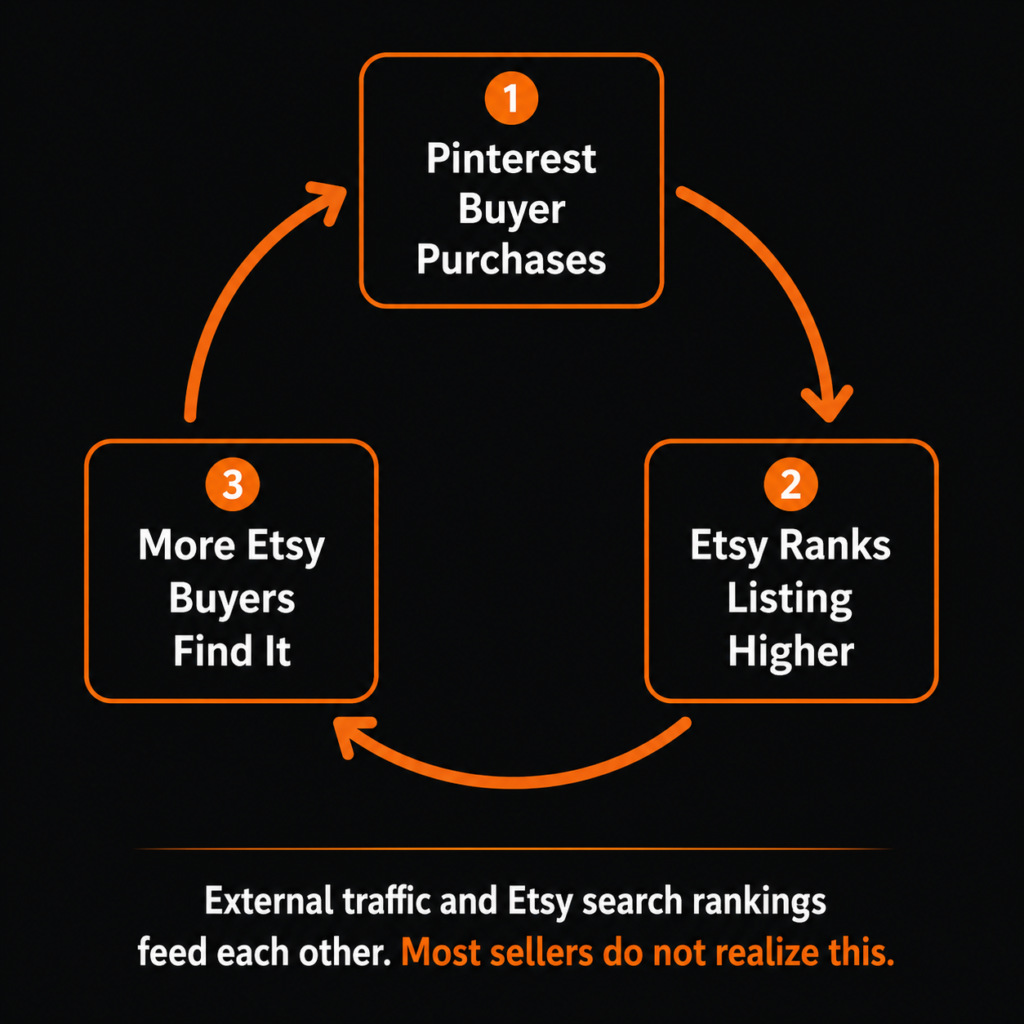
Here is what I figured out after digging into how Etsy traffic actually works: outside traffic and inside ranking are not two separate strategies. They feed each other.
When a buyer finds your listing through Pinterest and makes a purchase, Etsy takes that as a signal that your listing is popular and worth showing to more people in search results. The outside traffic improves the inside ranking. A purchase is a purchase — Etsy does not care where the buyer came from.
Most sellers who are stuck waiting for Etsy search to pick up their listings have no idea this is happening. They are treating Pinterest as a nice-to-have add-on when it is actually one of the fastest ways to accelerate how quickly Etsy search starts showing their listings.
This article covers how to get more traffic to your Etsy shop without paid ads — the three sources that actually work for digital product sellers specifically, and what to stop wasting time on.
Table of Contents
Why Outside Traffic Makes Etsy Show Your Listings More?
Every Etsy listing has a quality score. You cannot see it, but it is there.
Etsy builds that score based on how buyers behave when they encounter your listing — whether they click it, favorite it, add it to their cart, and most importantly, whether they buy it. Listings with strong engagement get shown to more people in Etsy search. Listings with weak engagement get shown to fewer people over time.
Here is the part most sellers miss: Etsy does not care where that engagement comes from.
A buyer who finds your budget planner listing through a Pinterest pin and purchases it counts exactly the same as a buyer who found it through Etsy search. Both purchases improve the listing quality score. Both tell Etsy the listing is worth showing more broadly.
This is why driving outside traffic — especially in the first 30 to 60 days of a new listing — can significantly accelerate how quickly that listing starts ranking in Etsy search. A new listing starts with zero purchase history and gets shown to very few people. External traffic seeds that history early and gets the compounding started faster.
It is also why the first sale matters so much more than most people realize — and why getting that first sale without an audience is worth spending real time on before anything else.
Source 1 — Etsy Search (Your Foundation)
Etsy search is still the largest source of traffic for most established shops. Roughly 70 to 80 percent of traffic for shops with some purchase history comes from inside Etsy.
The problem for new shops is that Etsy search is slow to deliver at the start. A listing with no purchase history has a low quality score and gets shown to very few people. That is exactly why external traffic matters most in the early months — it seeds the engagement that Etsy search ranking depends on.
Two things move the needle on Etsy search faster than anything else: listing count and listing quality. Each listing is a separate entry point into Etsy search. A shop with 10 listings has 10 chances to be found. A shop with 100 listings has 100 chances.
This section is the foundation. The real opportunity for most new digital product sellers is in what comes next — bringing buyers in from outside Etsy before Etsy search has had time to pick up the listings on its own.
Source 2 — Pinterest (How to Get More Traffic to Your Etsy Shop Without Paid Ads)
Most sellers treat Pinterest like another social media platform. Post a photo, hope someone sees it, move on.
That is the wrong mental model entirely.
Pinterest is a search engine. Users come to it with intent — they are actively looking for things to buy, make, or organize. Pinterest’s own data shows that 85% of weekly users have made a purchase based on content they saw on the platform — you can verify this in the Pinterest Business insights. They are looking for exactly that product. That search intent is what makes Pinterest traffic convert into Etsy sales in a way that Instagram and TikTok traffic almost never does.
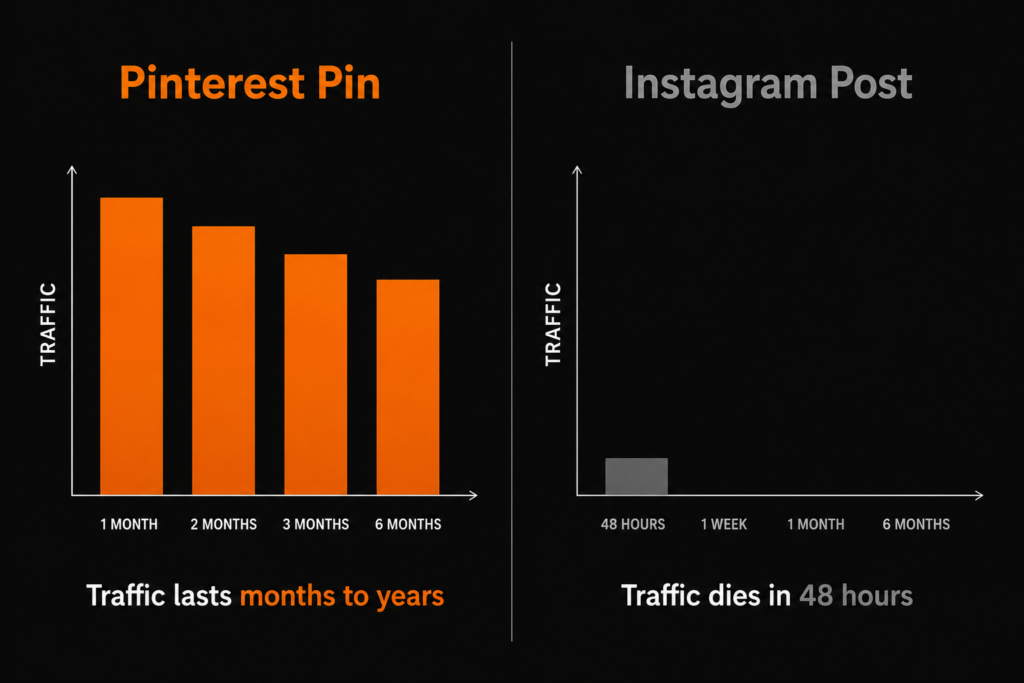
The other thing that makes Pinterest different: pins last. An Instagram post is essentially invisible after 48 hours. A Pinterest pin gets indexed, distributed, and can send traffic for months or years after it was posted. One well-made pin from six months ago can still be sending buyers to your listing today.
For digital products specifically, Pinterest is one of the highest-traffic categories on the entire platform. Planners, templates, printables, checklists, spreadsheets — these are exactly what Pinterest users are searching for and saving. The audience is already there. The question is just whether your listings are showing up for them.
Here is what actually works for digital product sellers on Pinterest:
Create vertical pins at 1000x1500px — that is the format Pinterest prioritizes in search results and feeds. Show the product in context, the same way your Etsy thumbnail should. A budget planner on a desk, a Canva template open on a laptop, a checklist printed and filled in. Lifestyle context earns the click.
Write keyword-rich descriptions for every pin. Pinterest is also a search engine, which means the words in your pin description determine who sees it. Use the same keywords that informed your Etsy listing title — the research you did finding your niche applies directly here.
Link every pin directly to the specific Etsy listing, not your shop homepage. A buyer who clicks a pin for a budget planner wants to land on that listing, not browse a shop and figure out where it is.
Pin consistently — three to five times a week is enough to build momentum. Results take three to six months to compound, but once they do they keep coming without ongoing effort in the way ads require.
The sellers who figure out Pinterest early are the ones who stop wondering why Etsy search is slow and start building a traffic source that feeds Etsy ranking at the same time.
Source 3 — Google (Free Traffic Most Sellers Ignore)
Most Etsy sellers do not think about Google at all. That is a mistake.
Etsy listings rank on Google. When someone searches “printable budget planner PDF instant download” on Google, Etsy listings can and do appear on page 1 of those results. That is free traffic arriving at your listing without you doing anything extra — if the listing is set up correctly.
The main lever for Google specifically is the first 160 characters of your listing description. That is what shows up as the preview text when your listing appears in Google search results. Most sellers either leave it to chance or paste their title in as the first line. Neither works.
Write that opening sentence like it is a Google ad for your product. Clear, specific, and written for the buyer who is about to click. “This printable budget planner helps you track monthly expenses, bills, and savings goals — available as an instant PDF download, no subscription needed.” That is 160 characters of Google real estate working for you every time someone searches that term.
The good news is that optimizing for Google traffic overlaps almost entirely with optimizing for Etsy search. Specific titles, clear descriptions, accurate categories — the same work that improves your Etsy ranking also improves your Google ranking. Sellers who have already done the listing optimization work are already partially capturing Google traffic without realizing it.
Google is a slow and quiet traffic source. It will not replace Pinterest or Etsy search. But it is entirely free, requires no extra platform, and compounds alongside everything else you are already doing.
What Not to Waste Your Time On
Most traffic guides tell you to do everything. Post on Instagram. Start a TikTok. Join Facebook groups. Build an email list. Run Pinterest. Optimize for Etsy search. Do all of it at once.
That advice is not wrong exactly. But for a new digital product shop with limited time, doing everything means doing nothing well.
Here is the honest version.
Instagram keeps users inside the app. The platform actively discourages outbound clicks — it wants people scrolling, not leaving. A buyer who sees your budget planner on Instagram and wants to purchase has to remember your shop name, open Etsy separately, search for it, and find the listing. Most do not. The friction kills the conversion. Instagram makes sense once you have a large following and strong brand recognition. As a traffic strategy for a new shop, it is one of the lowest-return activities you can spend time on.
TikTok has the same problem with an even shorter content lifespan. Videos get a burst of views for a day or two and then disappear. The audience is in entertainment mode, not buying mode. Digital product sellers with large TikTok followings do make sales — but they built the following first and the sales followed. The following is the strategy, not the individual videos.
Facebook groups are time-consuming, most groups prohibit direct promotion, and the conversion rate for digital products is low. Not worth the effort at the start.
None of this means these platforms are useless forever. It means they are not where a new digital product shop should spend its limited time before it has consistent traffic and sales coming from the sources that actually work.
If you have traffic arriving but it is still not converting into sales, the problem is usually the listing itself rather than the traffic source. The most common listing mistakes are covered in Why Your Etsy Shop Isn’t Getting Sales.
The Order That Makes Sense
Most traffic advice treats every strategy as equally urgent. Do everything at once and see what sticks.
That is not how it works in practice. Order matters.
Here is the sequence that makes the most sense for a new digital product shop:
First, get the listing foundation right. Before driving any outside traffic, the listing needs to be doing its three jobs — getting found in Etsy search, earning the click, and convincing the buyer to purchase. Sending Pinterest traffic to a listing with a weak thumbnail or a confusing description is wasted effort. The traffic arrives and leaves without buying, which actually signals to Etsy that the listing is not converting well.
Second, start Pinterest alongside publishing new listings. Do not wait until the shop is “ready.” Pin each listing as it goes live. The 3 to 6 month compounding timeline starts the day the first pin goes up — the sooner that clock starts, the sooner results arrive.
Third, let Google traffic come naturally. Well-optimized listings with strong opening description sentences will start picking up Google traffic without any extra effort. Check your Etsy Stats occasionally to see if Google is sending referrals and which listings are showing up.
Fourth, revisit Instagram and TikTok once the shop has consistent sales. At that point you have real results to share, real customer outcomes to show, and a product range worth browsing. Content on those platforms lands differently when there is already social proof behind the shop.
The mistake most sellers make is starting at step four before step one is done. They spend months on Instagram content while the listings themselves are not optimized and Pinterest has not been touched.
Getting your niche right before any of this starts matters too — if the products are not matched to what buyers are searching for, no traffic source will fix that. That foundational work is what finding low competition Etsy niches is built around.
Frequently Asked Questions
Does Pinterest actually send traffic to Etsy shops?
Yes — and for digital product sellers specifically, Pinterest is consistently one of the most effective free traffic sources available. The reason is that Pinterest users arrive with search intent, not just browsing intent. Someone searching “printable budget planner” on Pinterest is much closer to buying than someone who happens to see an Instagram post about the same product. The traffic is slower to build than paid ads but it compounds over time and does not stop the moment you stop posting.
How long does it take to see results from Pinterest?
Realistically 3 to 6 months of consistent pinning before you see meaningful traffic. Pinterest is a slow burn — pins take time to get indexed and distributed, and the platform rewards accounts that pin consistently over time. The upside is that a pin created today can still send traffic a year from now. It is the opposite of Instagram where a post is essentially invisible after 48 hours.
Should I use Etsy Ads to get more traffic?
Not until you have existing sales data. Etsy Ads work by bidding on search placements, and listings with no purchase history are difficult to run profitably because Etsy does not yet know which buyers are likely to convert on them. For a new digital product shop, the better move is to get a handful of organic sales first through Etsy search and Pinterest, build the listing quality score, and then consider ads on the listings that are already converting. Running ads on an unproven listing usually burns money without building anything.
Is Instagram worth the time for a new Etsy shop selling digital products?
Not as a primary traffic strategy at the start. Instagram keeps users inside the app — the platform actively discourages outbound clicks, which is the opposite of what you need when you are trying to send people to an Etsy listing. Instagram makes sense once you have something to show: consistent sales, real customer results, a product range worth browsing. For a shop with a handful of listings and no purchase history, the time spent on Instagram content would be better spent creating more listings and building out Pinterest.
Final Thoughts
Most sellers wait for Etsy search to find them. The ones growing fastest figured out that you do not have to wait.
Outside traffic and inside ranking are the same strategy. A Pinterest buyer who purchases your listing tells Etsy the listing is worth showing more people in search. That compounding effect is why sellers who start Pinterest early move through the income tiers faster than sellers who rely on Etsy search alone.
The sequence matters more than the volume. Get the listing right first. Start Pinterest as listings go live. Let Google traffic come naturally from well-optimized descriptions. Revisit Instagram and TikTok once there is something real to show.
None of this is fast. Pinterest takes 3 to 6 months to compound. Etsy search takes time to build listing quality scores. Google traffic arrives quietly and gradually. But every one of these sources keeps working without ongoing ad spend — and they feed each other in a way that paid ads never do.
The sellers earning consistent monthly income from digital products are almost never the ones who found a shortcut. They are the ones who built the right foundation, started the right traffic sources early, and gave it enough time to compound.
That is the whole game. There is no other version of it.