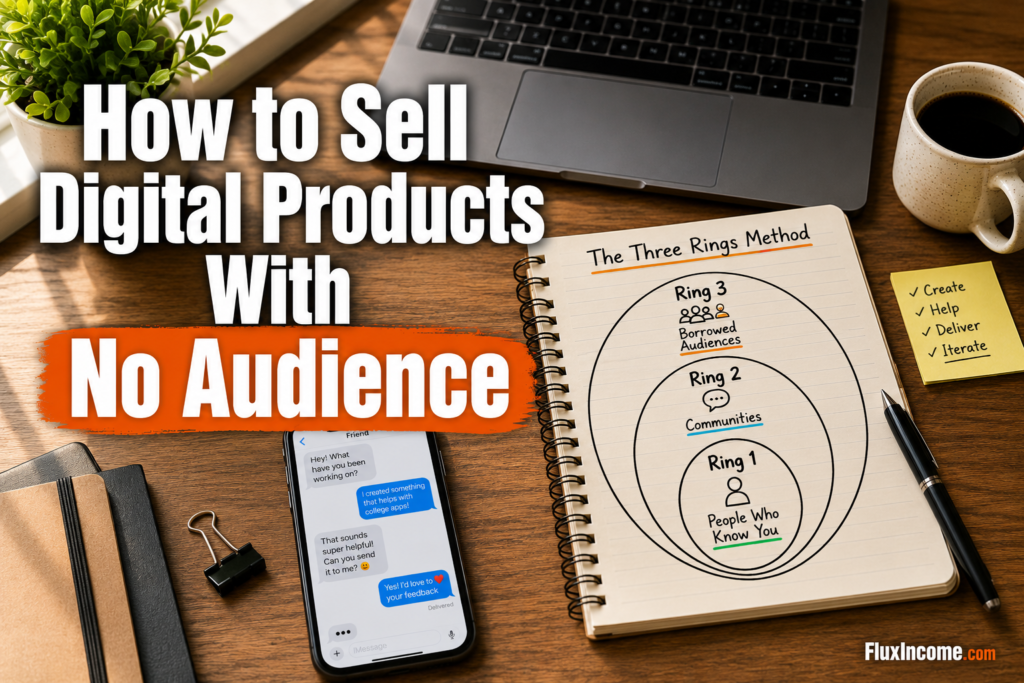
How to sell digital products with no audience?
It’s one of the most common questions beginners ask when they start exploring online business. Almost every guide seems to assume the same thing: first build an audience, then make sales.
At first, that sounded reasonable. If nobody knew who you were, why would anyone buy from you? The advice was usually some variation of the same formula: post consistently on social media, grow an email list, build authority, and eventually launch a product.
The problem was that very few people could explain what to do before the audience existed.
So I started looking for examples of people who had actually made sales without followers, without a large email list, and without spending months trying to become a creator first.
That’s when I found a college counselor named Dana.
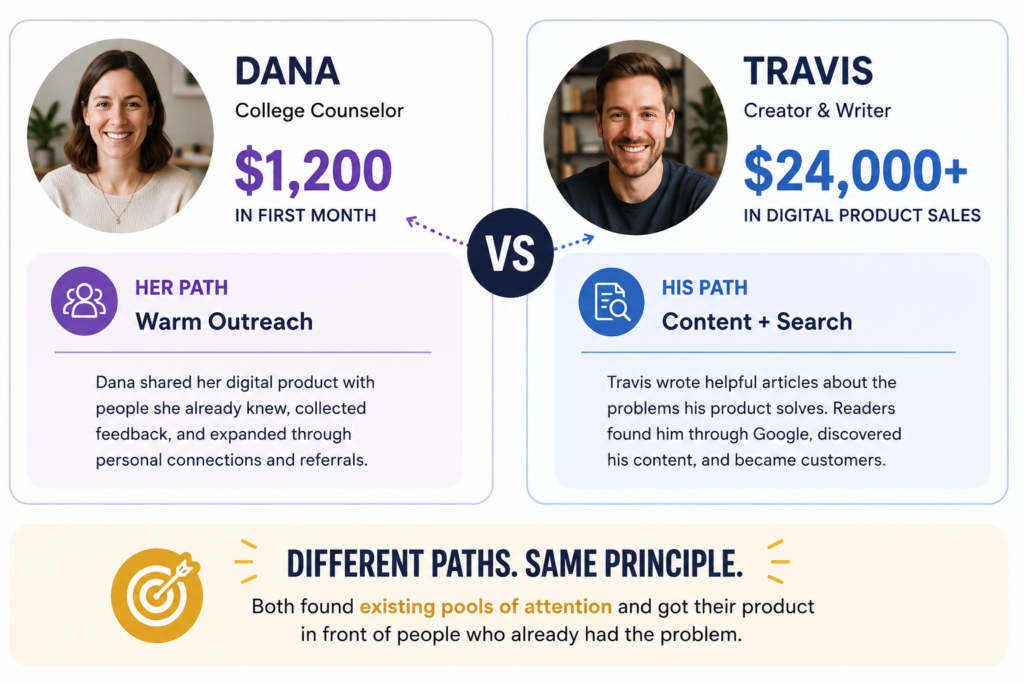
She had no Instagram audience, no email list, and no online following worth mentioning. Yet she made roughly $1,200 in her first month selling a simple digital product that helped parents navigate the college application process.
The more I researched, the stranger the pattern became.
Dana wasn’t the only example. I found creators using completely different methods and arriving at the same result: sales before audience.
What I discovered changed how I think about online business entirely.
The biggest mistake beginners make isn’t having no audience.
It’s believing they need one before they’re allowed to sell.
The Short Answer
Yes, you can sell digital products without an audience.
In fact, several of the most interesting examples I found started with almost no followers, no email list, and no paid advertising.
The mistake many beginners make is assuming that audience growth has to happen before sales. In reality, the relationship often works both ways. Sales can create an audience just as much as an audience can create sales.
That doesn’t mean selling without an audience is easy. It does mean the challenge is different than most people think.
Instead of asking how to become an influencer, a better question is how to get your first few customers, testimonials, and referrals. Once those pieces are in place, growth becomes much easier.
The good news is that the people I researched didn’t rely on luck, viral content, or huge social media followings.
They followed a handful of repeatable patterns that almost anyone can apply.
Table of Contents
Audience Is a Lagging Indicator, Not a Gate
One of the most common beliefs in online business is that you need an audience before you’re allowed to sell.
That’s why so many people spend months trying to grow followers, build an email list, or post content consistently before ever creating an offer.
The more examples I studied, the less that assumption held up. What I kept seeing was the opposite. Sales and audiences often grow together.
A customer becomes a testimonial. A testimonial creates trust. Trust leads to referrals. Referrals create more customers. Over time, those customers become the foundation of an audience.
That doesn’t mean audiences are unimportant. A large audience can absolutely make selling easier.
The mistake is treating audience size like a gate you have to pass through before making your first sale.
Many successful sellers start much smaller than people imagine. They begin with a handful of customers, a few conversations, or a product that solves a specific problem for a specific group of people.
That’s why I think the better question isn’t, “How do I build an audience first?”
It’s:
“How do I get my first few customers?”
Once I started looking at the problem that way, the examples I found began to make a lot more sense.
What Happened When Dana Started With Zero Followers
The first example that caught my attention was a college counselor named Dana, whose story was featured in a detailed case study on selling a digital product without an audience.
Unlike the online creators we usually hear about, Dana wasn’t starting with a large Instagram following, a popular YouTube channel, or a growing email list. She had no audience worth mentioning and no obvious advantage.
What she did have was a specific problem she understood well.
Parents were overwhelmed by the college application process, so Dana created a simple digital roadmap designed to help them navigate it.
The product wasn’t expensive. It sold for around $29.
What surprised me was what happened next.
Instead of spending months trying to build followers, Dana focused on getting the product in front of people who already trusted her. She shared it with people in her existing network, collected feedback, and gradually expanded beyond that initial circle.
By the end of her first month, she had generated roughly $1,200 in sales.
No viral post.
No paid ads.
No massive audience.
Just a useful product and a strategy that started much closer to home than most online business advice suggests.
The more I looked at her story, the more I realized that her success wasn’t really about social media at all.
It was about starting with access instead of waiting for attention.
A Completely Different Path to the Same Result
At this point, it would be easy to dismiss Dana’s story as a unique situation.
Maybe she succeeded because she already had industry knowledge. Maybe she simply knew the right people.
Then I came across a completely different example.
A creator named Travis Nicholson reported generating more than $24,000 in digital product sales without relying on a large audience or paid advertising.
What interested me wasn’t the amount of money.
It was the method.
Instead of starting with relationships, Travis focused on content. He identified a problem his product solved, wrote helpful articles about that problem, and published them on Medium.
Because Medium already had strong domain authority and existing search traffic, people could discover his content through Google without ever knowing who he was beforehand.
When readers found an article that solved part of their problem, Travis simply presented his product as a logical next step.
The pattern was completely different from Dana’s.
Yet the result was remarkably similar.
Neither creator spent months waiting for an audience before selling.
They found a way to reach people who already had the problem their product solved.
That distinction turned out to be more important than follower count.
At first, Dana and Travis seemed to be following completely different strategies. One relied on relationships. The other relied on content and search.
But the more I compared their stories, the more I noticed the same underlying pattern.
What These Two Stories Have in Common
At first, Dana and Travis seemed to be following completely different strategies.
One relied on relationships.
The other relied on content and search.
But the more I compared their stories, the more I noticed the same underlying pattern.
Neither person spent months waiting for an audience before taking action.
Instead, they focused on getting their product in front of people who already had the problem it solved.
Dana started with people she already knew and gradually expanded outward.
Travis published helpful content where potential buyers were already searching for answers.
The methods were different, but the principle was the same.
Both found existing pools of attention instead of trying to create attention from scratch.
That idea kept showing up in other examples too.
A seller on Creative Market made early sales not because she had a large following, but because her products were placed inside a marketplace where buyers were already looking for stock photos and creative assets.
The more examples I found, the clearer the pattern became.
Successful sellers weren’t waiting for an audience before selling.
They were finding places where buyers already existed.
The Three Rings Method
After looking at Dana’s story, Travis’s story, and several other examples, I kept noticing the same pattern.
Nobody started by trying to build a massive audience. Instead, they started with the people and places closest to the problem they were solving.
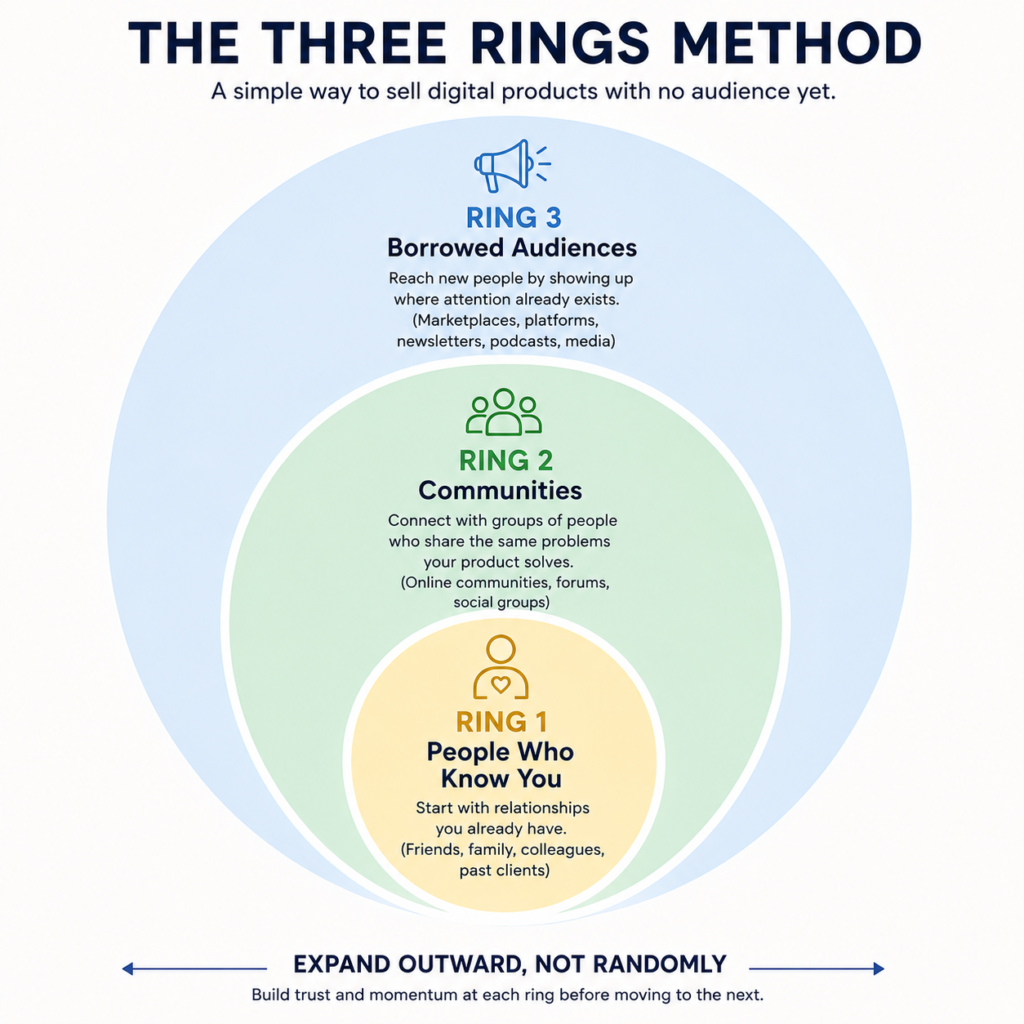
The more I thought about it, the more it felt like three expanding circles.
You start at the center, where trust is highest and competition is lowest. Then you gradually move outward.
I started thinking of it as The Three Rings Method.
The goal isn’t to reach the most people possible. The goal is to reach the right people in the right order. Each ring expands your reach while building on the trust and momentum created by the previous one.
That’s what makes the method work.
Ring 1: People Who Already Know You
Most people skip this ring because it feels too small.
They assume the answer must be somewhere out on the internet, hidden behind more followers, more content, or more traffic.
But Dana’s story showed the opposite.
Before she reached strangers, she started with people who already knew her and understood the problem she was solving.
That doesn’t mean asking friends and family to buy your product.
In most cases, that’s the wrong approach.
A better approach is to ask whether they know someone who has the problem your product solves.
For example, if you created a budgeting spreadsheet, the goal isn’t to convince your cousin to buy it. The goal is to find the person in their network who is actively trying to get their finances under control.
This ring is also the best place to gather feedback.
Giving your product to three or four people in exchange for honest opinions can help you identify confusing sections, improve the offer, and collect testimonials that make future sales easier.
That’s exactly why Ring 1 comes first.
The goal isn’t volume.
The goal is proof.
A few conversations, a few users, and a few testimonials can teach you more than months of posting content to an audience that doesn’t exist yet.
Ring 2: Communities Where Your Buyer Already Hangs Out
Once you’ve gathered some feedback and confidence from Ring 1, the next step is expanding into communities where your potential buyers are already asking questions.
This is where many beginners make a costly mistake.
They join a Reddit community, Facebook group, or forum and immediately start promoting their product.
Most communities hate that.
What works much better is becoming genuinely useful first.
The best advice I found followed a simple rule: if your comment would still be valuable after removing every mention of your product, you’re probably contributing rather than promoting.
That’s why Dana’s approach worked. She didn’t begin by trying to sell to strangers. She focused on helping people who were already dealing with the problem her product solved.
The same principle applies whether you’re selling budgeting spreadsheets, Etsy templates, fitness plans, or digital planners.
Start by answering questions.
Share experiences.
Offer useful advice.
Over time, people naturally become curious about who you are and what you do.
Ironically, trying less aggressively to sell often leads to more opportunities to sell.
The same principle applies on marketplaces like Etsy. Many sellers assume they need more products or lower prices when sales are slow, but the real problem is often visibility. If you’re already selling on Etsy and struggling to get traction, I break down the most common causes in my guide on why your Etsy shop isn’t getting sales.
The goal of Ring 2 isn’t immediate revenue.
It’s trust at scale.
Instead of reaching a handful of people, you’re now helping dozens or hundreds of people who already fit your target audience.
Ring 3: Borrowed Audiences
The third ring is where growth starts accelerating.
By this point, you’ve already gathered feedback, improved your product, and learned how to talk about it in a way that resonates with real people.
Now you’re no longer relying entirely on your own reach.
You’re borrowing attention from people who already have it.
One of the most interesting parts of Dana’s story was what happened after her first sales.
Instead of trying to build everything herself, she partnered with other creators serving the same audience. Together, they combined products into bundles that offered more value than any single product could provide alone.
A parent looking for help with college applications didn’t just get Dana’s roadmap. They might also receive a scholarship tracker, an essay checklist, or a planning guide created by someone else.
Everyone involved benefited.
Buyers received a stronger offer, and creators gained exposure to audiences they couldn’t have reached on their own.
The same idea works beyond bundles.
Guest articles, newsletter partnerships, podcast appearances, marketplace platforms, and strategic collaborations all allow you to reach people who already trust someone else.
That’s why I think of Ring 3 as leverage.
Instead of building every audience member one at a time, you’re placing your product in front of groups of people who are already paying attention.
Why Warm Beats Cold (And Why the Order Matters)
One thing I kept noticing throughout my research was that the order of the rings mattered just as much as the rings themselves.
Dana didn’t start with partnerships.
She didn’t start by trying to reach thousands of strangers.
She started with people who already trusted her.
That turns out to be more important than it might seem.
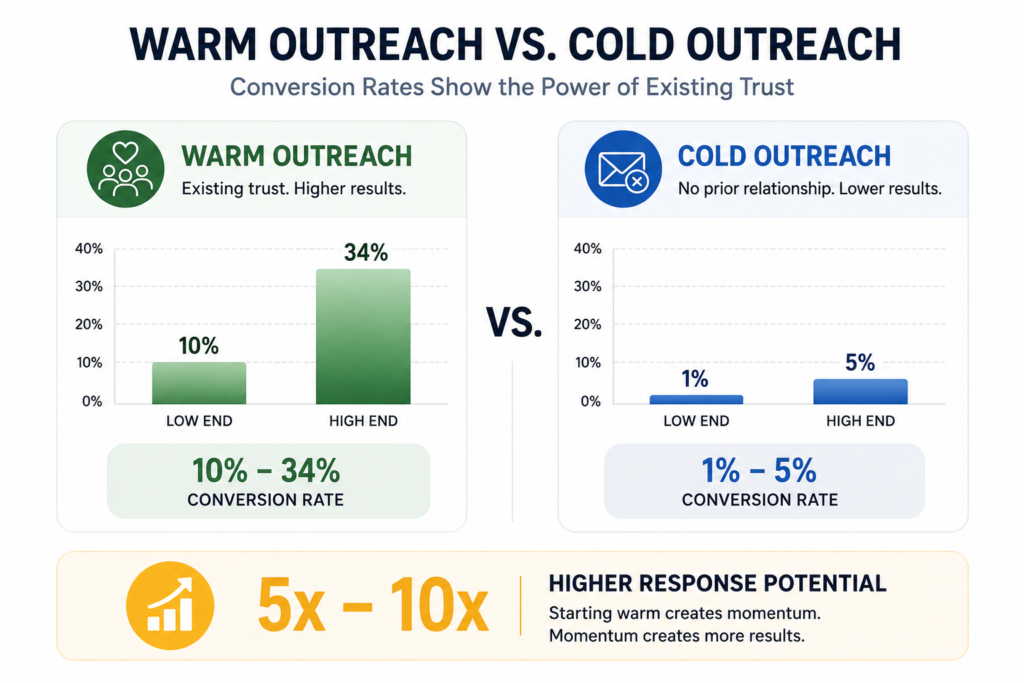
According to outreach data, cold outreach with no prior relationship often converts at rates between 1% and 5%, while warm outreach, where some level of trust or familiarity already exists, can convert between 10% and 34%.
That’s a massive difference.
It helps explain why so many beginners get frustrated when they jump straight into social media promotion, cold outreach, or paid traffic.
They’re starting with the hardest audience first.
The Three Rings Method works because it moves in the opposite direction.
You begin where trust already exists.
Then you expand into communities where people already recognize the problem.
Only after that do you start leveraging larger audiences and partnerships.
Each ring makes the next one easier.
That’s why the goal isn’t reaching the largest number of people as quickly as possible.
The goal is building momentum one layer at a time.
The Mistake That Keeps Beginners Stuck for Months
After reading dozens of case studies, forum discussions, and creator stories, I noticed the same pattern repeating again and again.
Most people weren’t failing because they lacked an audience.
They were failing because they were waiting for one.
Instead of creating an offer and testing it with real people, they spent months designing logos, planning content calendars, choosing social media platforms, and trying to grow followers.
It feels productive.
But in many cases, it’s just a more comfortable form of procrastination.
The problem is that audiences don’t automatically create successful products.
A large audience can help distribute a good product, but it can’t fix a product nobody wants.
That’s why I think the people who start selling earlier often learn faster.
Every conversation teaches them something.
Every piece of feedback improves the product.
Every sale reveals what buyers actually care about.
Meanwhile, the person waiting to “build an audience first” is still making assumptions.
If I had to start from zero today, I wouldn’t spend six months trying to become an influencer.
I’d spend that time talking to potential buyers, testing ideas, improving the product, and moving through the three rings one step at a time.
That’s the pattern I kept seeing in the examples that succeeded.
Frequently Asked Questions
Can you sell digital products without an audience?
Yes. Many creators make their first sales before building a large audience by starting with existing relationships, online communities, marketplaces, or borrowed audiences. The key is getting your product in front of people who already have the problem it solves.
How do I sell digital products with no audience?
The most effective approach is to start small. Share your product with people who can provide feedback, participate in communities where your target customers already spend time, and gradually expand through partnerships, marketplaces, and content.
What is the best platform to sell digital products without an audience?
It depends on the product. Marketplaces such as Etsy, Creative Market, and other discovery-driven platforms can help new sellers reach buyers more quickly because traffic already exists on the platform.
Should I build an audience before creating a product?
In most cases, no. Creating and testing a product early can provide valuable feedback and help validate demand. Many successful sellers improve their products based on customer conversations rather than waiting until they have a large audience.
Is social media required to sell digital products?
No. Social media can help, but it’s only one way to reach customers. Community participation, marketplaces, referrals, partnerships, content marketing, and search traffic can all generate sales without a large social following.
Final Thoughts
When I started researching how to sell digital products with no audience, I expected to find a shortcut for building followers faster.
Instead, I found something much more useful.
The creators getting results weren’t waiting for an audience before they started selling. They were finding ways to reach people who already had the problem their product solved.
Dana did it through relationships.
Travis did it through content and search.
Other creators did it through communities, marketplaces, partnerships, and referrals.
The methods were different, but the pattern was remarkably consistent.
They started with access before attention.
That’s why I think the biggest mistake beginners make isn’t having a small audience.
It’s treating audience growth as a prerequisite for sales instead of a byproduct of solving real problems for real people.
If you’re starting from zero, don’t focus on reaching everyone.
Focus on reaching the first few people who genuinely need what you’ve created.
Get feedback.
Improve the product.
Collect testimonials.
Then expand outward one ring at a time.
The audience often comes later.
The first sale doesn’t have to.
Pingback: How Much Can You Make Selling Digital Products on Etsy? (The Real Numbers) - Flux Income
Pingback: How to Get More Traffic to Your Etsy Shop Without Paid Ads