$700 lands in your checking account. Same account your paycheck goes into. It feels simple — it’s just money, and money is money.
Two weeks later, you try to figure out where things stand. How much of that $700 is actually yours to spend? How much is owed in taxes? Did any of it already get spent on groceries, gas, a bill that came due? You genuinely can’t tell anymore. The side hustle money and the salary money aren’t two separate things now — they’re just “the money in your account,” and untangling them after the fact is nearly impossible.
This is exactly why you need a separate bank account for your side hustle — not as a bookkeeping formality, but because a system you have to remember isn’t a system. If keeping your side hustle income straight depends on you mentally tracking which dollar came from where, the system was never really working — you were just getting lucky.
That’s what this article fixes. If you’ve already set up your Two-Pot System, you know the theory: salary protects your present, side hustle builds your future, and the two are never supposed to mix. This is where that theory becomes real — the Three-Lane System, a simple account setup that keeps your money separated automatically, so you never have to hold it all in your head.
Side hustlers bring in $810 a month on average — real money, not pocket change. It deserves a system that runs on its own, not one that depends on you remembering.
Table of Contents
Why “I’ll Just Keep Track Mentally” Doesn’t Work
It sounds reasonable enough at first. You’ll just remember. You’ll check your balance, do some quick math in your head, keep it all straight. No need for extra accounts, extra apps, extra steps.
It works fine — for about a month. Then a bill comes due early. Or a slow week blurs into a good week. Or you simply forget the exact number you’d mentally set aside for taxes. The moment that happens, your salary and your side hustle income aren’t two separate things anymore. They’re just money, sitting in the same place, with no way to tell which dollar was supposed to do what.
Think of it like pouring clean water into dirty water. For a second, you can still sort of picture where each one came from. But once they’ve mixed, they’ve mixed — there’s no version of “let me just pull the clean water back out” that actually works. The only real fix is to never let them touch in the first place.
That’s the entire idea behind physical separation. Not because you’re bad with money, and not because you need more willpower. It’s because mental tracking asks you to do something no system should ever ask of you: hold everything perfectly in your head, indefinitely, without a single slip. The Three-Lane System removes that requirement entirely — your money sorts itself before you ever have to think about it.
The Three-Lane System
Once you accept that mental tracking doesn’t hold up, the fix is simple: give your money three separate lanes to travel through, so it sorts itself before you ever have to think about it.
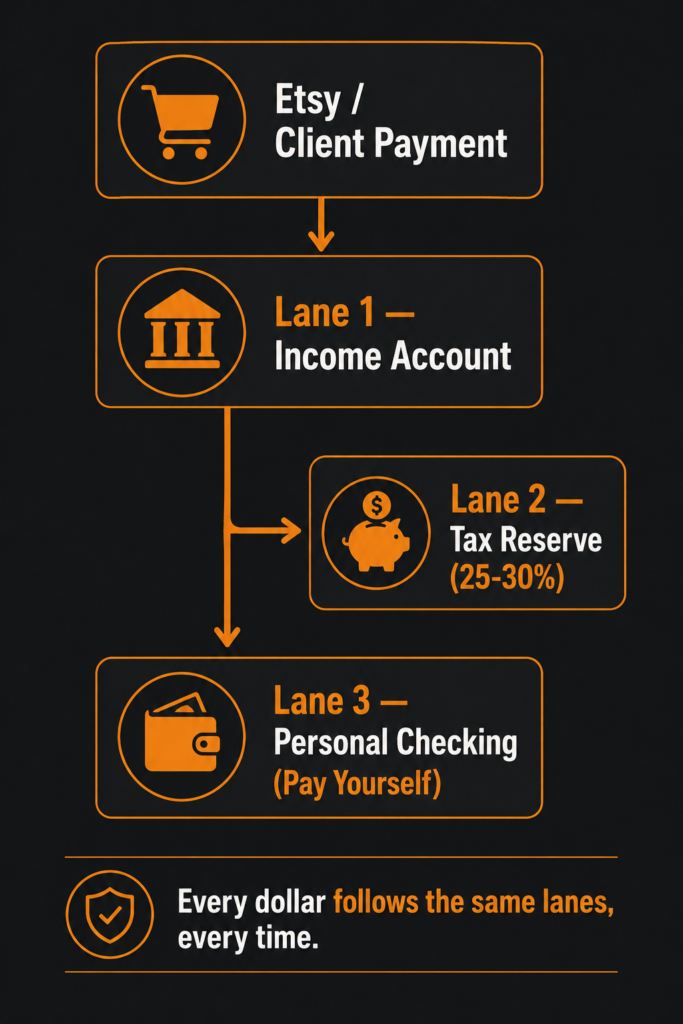
Lane 1 — Income Account. Every dollar your side hustle brings in lands here first. Nothing else touches this account — no groceries, no bills, no personal spending. Its only job is to be the first stop for side hustle money, before it becomes anything else.
Lane 2 — Tax Reserve Account. The moment income hits Lane 1, 25-30% moves straight into this account. This is the same rule from the Two-Pot System’s allocation order — taxes first, no exceptions. Once it’s here, it’s untouchable.
Lane 3 — Personal Checking. What’s left after taxes gets paid to yourself in a consistent amount, landing in the same personal checking account where Pot 1 — your salary — already lives. This is the only point where side hustle money rejoins your everyday life, and only after it’s already done its job.
If you’ve already set up your Two-Pot System, this will feel familiar — Lane 1 and Lane 2 are really just Pot 2 getting its own physical home, instead of living as a mental category inside one shared account. Lane 3 is simply where Pot 2 hands off to Pot 1’s world, once taxes are already covered.
The whole point of naming these lanes is that you don’t have to decide anything each time money arrives. The dollar already knows where it’s going.
Do You Need a Business Account?
No — you probably don’t need a business bank account yet.
That might come as a relief, because the phrase “business account” tends to conjure up paperwork, extra fees, and a level of formality that feels miles away from an Etsy shop or a freelance gig on the side. The good news: for most people just starting to separate their money, a second personal checking or savings account does the job perfectly well. Lane 1 and Lane 2 don’t need to be business accounts — they just need to be separate from your everyday spending.
A true business account starts to earn its keep once your side hustle income becomes consistent and sizable enough that things like liability protection, business credit, or formal bookkeeping actually matter — usually once you’re bringing in steady income month after month, not just the occasional sale. Until then, adding business banking complexity on top of a side hustle you’re still building out is solving a problem you don’t have yet.
Start simple. Two extra personal accounts, set up in an afternoon, is enough to make the Three-Lane System work from day one.
Making Your Tax Reserve Untouchable
Setting aside 25-30% of every payment is the easy part. Actually leaving it alone is where most people slip.
The trick isn’t a stricter rule — it’s a shift in how you think about that money. The moment it lands in Lane 2, stop thinking of it as savings. It was never yours to spend in the first place. You’re not setting money aside; you’re just moving money that already belonged to someone else out of your way. That small reframe does more to protect it than any amount of willpower.
Automation helps make that reframe stick. Set up an automatic transfer so the moment income hits Lane 1, the tax percentage moves to Lane 2 without you having to remember to do it — the same way YNAB can automate Pot 2’s allocation order once income arrives. A high-yield savings account is worth using here too, since Ally Bank or Marcus by Goldman Sachs currently offer around 4% APY on money that would otherwise just sit there. It’s not the main point — the main point is that this money is already spoken for — but there’s no reason not to earn something on it while it waits.
Exactly how much to set aside depends on your situation — a full breakdown of the calculation goes deeper once you’re ready for the specifics. For now, 25-30% is a safe, simple starting point that keeps you covered without overthinking it.
What This Protects You From
There’s a practical upside to all this beyond just peace of mind. If you’re ever audited, the IRS can only see your business-related bank statements directly — pulling your personal accounts into it requires a specific additional request, giving you a genuine layer of separation. And come tax season, having everything already sorted into its own lane saves you from the hours most people spend combing through mixed transactions trying to reconstruct what belonged to what.
Those are real benefits. But they’re not really the point. The point is that you already know where every dollar stands, every single day, without having to think about it.
Frequently Asked Questions
Do I really need a separate bank account for a small side hustle?
Yes — you need a separate bank account for your side hustle arguably more than someone earning a lot, since small amounts are the easiest to lose track of. A $50 payment feels too small to bother separating, but those small payments add up, and without a dedicated account, they blend into everyday spending before you even notice. The Three-Lane System works the same whether you’re earning $50 a month or $2,000.
What if I already spent some of my side hustle income before separating it?
Start from today, not from zero. Move whatever side hustle income you can identify right now into Lane 1, set aside taxes on it, and let every new payment from here on follow the lanes properly. You don’t need to reconstruct the past perfectly — you just need the system running cleanly going forward.
Can I use one account for both the income lane and the tax lane?
You can, but it defeats the purpose. The whole reason Lane 2 works is that it’s a separate, slightly harder-to-touch place for money you’ve mentally already spent. Combine it with Lane 1 and you’re right back to eyeballing a single balance and hoping you remember what’s spoken for.
How often should I move money between the lanes?
Every time a payment arrives, not on a schedule. Waiting until the end of the month means relying on memory again — which is exactly the habit this system exists to remove. Set up automatic transfers if your bank allows it, so the lanes stay accurate without you having to act every time.
Final Thoughts
A system you have to remember isn’t a system.
That’s really what this whole article has been about. Not bank accounts for their own sake, not tax compliance, not looking more professional — just the simple fact that money you have to track in your head eventually gets untracked. The Three-Lane System isn’t extra effort. It’s what removes effort, by giving every dollar somewhere to go before you ever have to decide.
That’s really the whole reason you need a separate bank account for your side hustle in the first place — not for paperwork, but so the system runs without you. The goal was never to become someone who’s really good at remembering where their money should go. The goal is to build a setup so automatic that it goes to the right place on its own — and the Two-Pot System you already believe in finally has somewhere real to live.
Pingback: How to Budget Side Hustle Income (The Two-Pot System)
Pingback: How Much to Set Aside for Taxes for Your Side Hustle
Pingback: How to Track Side Hustle Income and Expenses (No Accountant)