Your first real side hustle payment feels different from your paycheck. It feels like a bonus — money that showed up because of something extra you did, not something you’re owed. So you spend it. A new pair of shoes, a nice dinner, something you’d been putting off.
Then next month is slow. $150 instead of $800. The bills still come. Except now you’ve got nothing left over, and somehow you feel worse off than before you started your side hustle — despite working more hours than ever.
The problem was never the slow month. The problem is that nobody showed you how to budget side hustle income before it arrived.
Your salary protects your present. Your side hustle builds your future. Those are two different jobs, and they need two different systems. That’s the whole idea behind the Two-Pot System — a simple way to keep your salary and your side hustle income completely separate, so one bad month never touches the other.
By the end of this article, you’ll have a real system for handling every dollar of side hustle income the moment it lands — before it has the chance to become an impulse buy.
Table of Contents
Why Budgeting Breaks When You Add Side Hustle Income
Most budgeting advice assumes one income stream, which is exactly why so many people struggle to budget side hustle income the same way they budget a salary. You get a paycheck, you build a budget around it, you adjust as needed. That works fine — right up until a second, unpredictable income stream enters the picture.
Side hustle income doesn’t behave like a salary. One month it’s $800. The next it’s $150. If you fold that income into your regular budget the way most advice tells you to, you’re building your fixed expenses — rent, groceries, insurance — on a number that moves every month. When it drops, your bills don’t drop with it.
Federal Reserve research has found gig workers experience significantly more month-to-month income swings than people without a side income — which is exactly why a system built for steady paychecks doesn’t hold up here.
Think of it like a car. Your salary is the engine — it’s what actually moves the car forward, mile after mile, regardless of conditions. Your side hustle is the turbocharger — it adds real power when it’s running, but the car was never designed to depend on it. If the turbo cuts out, the engine keeps the car moving. If the engine cuts out, nothing else matters.
That’s the whole flaw in treating side hustle income like extra paycheck money: it puts the turbocharger in charge of things only the engine should handle. If you’re new to side hustle income and still figuring out what realistic monthly numbers even look like, this breakdown of real Etsy shop earnings is worth reading first — it shows just how much a “slow month” can swing.
The fix isn’t a better budget. It’s a completely different structure — one where your salary and your side hustle income never depend on each other. That’s what the Two-Pot System does.
How the Two-Pot System Helps You Budget Side Hustle Income
Here’s the fix: stop treating your side hustle income as an extension of your paycheck. Give it its own system entirely. This is the core idea behind how to budget side hustle income without it disrupting the rest of your finances.
Pot 1 — Protects Your Life. This is your salary. It covers every fixed expense you have: rent, groceries, insurance, subscriptions, bills. It runs on a normal budget, and it never factors in a single dollar of side hustle income. If your side hustle disappeared tomorrow, Pot 1 alone should still cover your life.
Pot 2 — Builds Your Future. This is every dollar your side hustle brings in. It follows its own rules, has its own allocation order, and never touches your fixed expenses. Pot 2 isn’t extra spending money — it’s the pot doing the work of building something for later.
The one rule the whole system depends on: the two pots never mix. Not “rarely.” Not “unless it’s tight this month.” Never. The moment side hustle income starts covering a bill it was never meant to cover, the whole system collapses back into the same guesswork you started with.
This is why the car analogy matters so much. The engine (Pot 1) runs the car regardless of what the turbocharger is doing. The turbocharger (Pot 2) adds power on top — but it was never wired into anything the engine depends on. Keep that separation, and a slow side hustle month becomes a non-event instead of a crisis.
Everything else in this article — the allocation order, the accounts, the slow-month math — is just the detail of how to keep these two pots honestly separate.
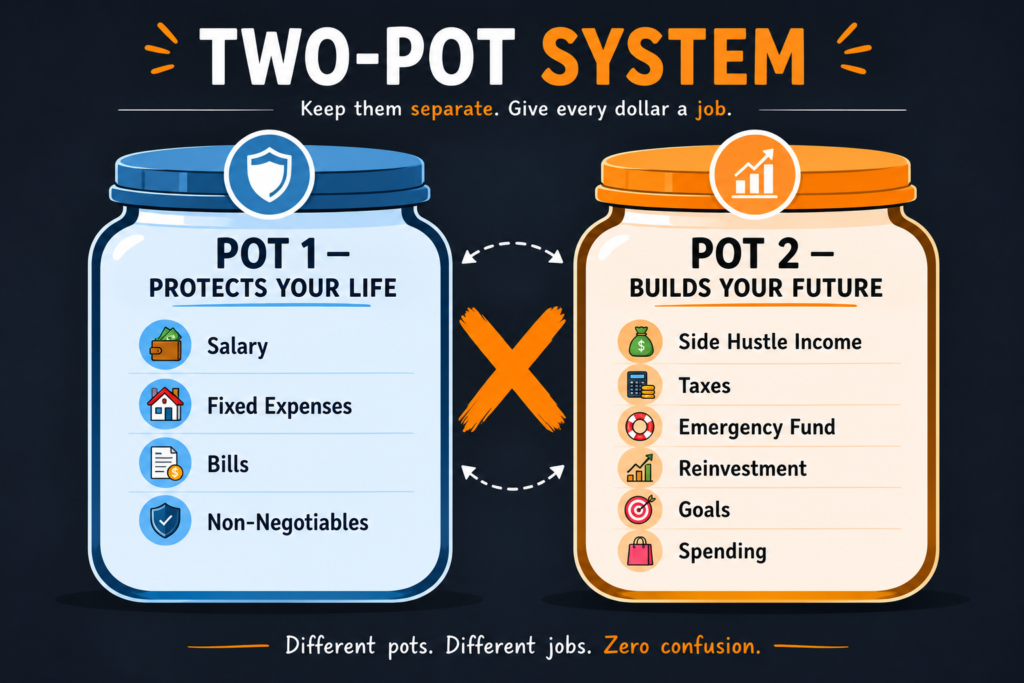
Pot 1 — Protect Your Life (Keep It Simple)
Pot 1 doesn’t need much explanation, and that’s the point. This is your salary, and its only job is covering everything non-negotiable — rent, groceries, utilities, insurance, minimum debt payments. A simple 50/30/20 split (needs, wants, savings) is a solid starting point if you don’t already have a system in place.
The one thing to get right: build this budget as if your side hustle didn’t exist. No “it’ll probably even out” thinking, no side hustle income penciled in to cover a shortfall. If Pot 1 only works when Pot 2 shows up, you don’t have the Two-Pot System — you have the same fragile, single-budget problem this whole article is trying to fix.
Pot 2 — The Allocation Order for Budgeting Side Hustle Income
This is where the real work of learning how to budget side hustle income actually happens. Every time side hustle income arrives, it moves through five steps, in order, before a single dollar becomes spending money.
1. Taxes first. Before anything else, 25-30% of every payment goes straight into a separate savings account. Not because it’s the most exciting step — because it’s the one with zero flexibility. That money was never really yours to begin with, and treating it that way from day one means tax season never becomes a scramble.
2. Emergency fund second. Once taxes are set aside, the next priority is a buffer — ideally 3-6 months of expenses sitting untouched in its own account. This is what makes a slow month survivable instead of stressful. Without it, every dip in income feels like a crisis. With it, a slow month is just a slow month.
3. Reinvestment third. Around 10-20% goes back into the side hustle itself — tools, courses, marketing, whatever helps it grow. This step is capped on purpose. Reinvesting everything means your side hustle grows while your actual financial life never changes.
4. Financial goals fourth. Debt payoff, long-term savings, investing — whatever’s next on your list. This comes before spending because long-term progress is the actual point of Pot 2. It’s not just money that showed up; it’s money with a direction.
5. Spending last. Whatever’s left after the first four steps is genuinely guilt-free, because it’s not competing with taxes, a safety net, growth, or goals. It already lost those arguments and won anyway.
Here’s what that looks like on a real $500 Etsy payment: $125-150 to taxes, $100 to the emergency fund, $50-75 back into the shop, the remainder split between financial goals and spending. Five decisions, made once, in under a minute — instead of five decisions made all month long under pressure.
An app like YNAB makes this easier to automate, since it’s built around assigning every dollar a job the moment it arrives rather than projecting from an average monthly income — which fits this allocation order almost exactly. A simple spreadsheet works too if you’d rather not pay for another subscription.
The exact tax percentage depends on your situation — a full breakdown of what to actually set aside goes deeper into the calculation once you’re ready for the specifics.
The Reinvestment Balance
Reinvestment is the step people get wrong in two opposite directions.
The first failure mode: reinvesting everything. Every dollar Pot 2 brings in goes right back into better tools, more ads, another course. The side hustle keeps growing — but the person running it never actually gets ahead. A year in, the shop looks more professional and the bank account looks exactly the same.
The second failure mode: reinvesting nothing. All of Pot 2 flows straight to goals and spending, and the side hustle itself never improves. It stalls out at whatever level it started at, because nothing is going back into the thing that’s supposed to keep growing.
The balance is 10-20% back into the business — enough to keep it moving forward, not so much that it swallows every other priority. For an Etsy seller, that might mean Canva Pro for better listing images, eRank for keyword research, or Tailwind for scheduling — small, specific investments, not a blank check.
What Happens in a Slow Month
Month one, the Etsy shop brings in $800. It feels incredible. The allocation runs exactly as planned — taxes set aside, emergency fund topped up, a little back into the shop, the rest moving toward goals and a well-earned treat. Side hustle income, working exactly the way it’s supposed to.
Month two, it’s $150.
For most people, this is where the panic sets in. Bills suddenly feel tight. The side hustle starts to feel like it was a mistake — all that extra effort for a month that barely moved the needle. Some people quit right here, convinced the whole thing isn’t worth it.
Here’s what actually happens with the Two-Pot System running: nothing. Pot 1 covers the bills exactly like it did in month one, because it was never depending on the side hustle in the first place. Pot 2 simply has less to allocate this month — a smaller slice of taxes, a smaller contribution to the emergency fund, less going everywhere. No scrambling. No crisis. No late-night math trying to figure out what to cut.
Back to the car: the turbocharger just ran a little slower this month. The engine kept driving exactly like it always does. That’s the entire point of keeping the two pots separate — a bad month in Pot 2 stays contained to Pot 2. It never becomes a bad month in your actual life.
The Two Accounts You Need to Make This Work
The Two-Pot System isn’t just a mindset — it needs two physical accounts to actually work. Without them, “keeping the pots separate” is just a nice idea that quietly falls apart the first time money gets tight.
A Taxes account. Every time side hustle income arrives, 25-30% moves here immediately — not at the end of the month, not “when you get around to it.” The moment the money lands, it moves. This account exists for one purpose and one purpose only, and it should feel almost invisible day to day.
An Emergency Fund account. This is where your buffer builds, payment by payment, until it covers 3-6 months of expenses. Keeping it separate from your regular checking account matters more than it sounds like it should — money sitting in the same place as your everyday spending has a way of quietly getting spent.
Both accounts work best as high-yield savings accounts rather than a regular checking or savings account, since you’re earning something on money that’s sitting there anyway. Ally Bank and Marcus by Goldman Sachs both offer competitive APYs with no minimum balance or monthly fees, which makes them a natural fit for this kind of dedicated, hands-off account.
Once these two accounts exist, the entire allocation order in Pot 2 stops being a mental exercise and becomes something that just happens automatically every time money comes in. Setting up a dedicated account structure is really the natural next step once the Two-Pot System clicks — it’s what makes the whole thing stick long-term.
Frequently Asked Questions
Should I include side hustle income in my regular budget?
No — this is the most important rule in the whole system. Side hustle income is variable, and folding it into your regular monthly budget means your fixed expenses are quietly depending on a number that changes every month. Keep your salary budget and your side hustle allocation completely separate. Your salary protects your present. Your side hustle builds your future. Two different jobs, two different systems.
How much of my side hustle income should I save vs. spend?
After taxes (25-30%) and your emergency fund contribution, a reasonable starting split for what’s left is roughly 15-20% back into the business, 50-60% toward financial goals, and 20-30% for spending. The right split shifts depending on where you are — more toward debt payoff if you’re carrying high-interest debt, more toward the emergency fund if it isn’t fully built yet.
What budgeting app works best for side hustle income?
YNAB tends to work best here, since it’s built around giving every dollar a job the moment it arrives rather than projecting from an assumed monthly income — which lines up almost exactly with how Pot 2 is meant to work, and makes it one of the easiest ways to automate how you budget side hustle income without doing manual math every month. If you’d rather not add another subscription, a simple spreadsheet paired with two dedicated savings accounts does the same job.
What should I do with side hustle income in a really good month?
Run the same allocation order — just with more money moving through it. Taxes first, emergency fund next if it isn’t full, then reinvestment, goals, and spending. A great month isn’t permission to skip the order; the biggest mistake people make with a high-earning month is treating the surplus as extra spending money instead of using it to move faster on the goals that actually matter.
Final Thoughts
Your salary protects your present. Your side hustle builds your future.
That’s the whole system, said in one sentence. Everything else in this article — the accounts, the allocation order, the reinvestment math — is just the practical detail of keeping that one idea true, month after month, good months and slow ones alike.
The goal was never for your side hustle to pay today’s bills. Your salary already does that job, and it should keep doing it regardless of what your side hustle earns. The goal is to build your side hustle carefully enough that one day, it could — if that’s ever what you want. That’s really the whole answer to how to budget side hustle income — give every dollar a job before it arrives.
Pingback: Why You Need a Separate Bank Account for Your Side Hustle
Pingback: How Much to Set Aside for Taxes for Your Side Hustle
Pingback: What to Do With Side Hustle Income: Your First Paycheck
Pingback: How to Build an Emergency Fund on Variable Income