There is a moment every side hustler waits for. You open your payment dashboard, add up the month, and the number is bigger than your paycheck.
It feels like the finish line. Your side hustle makes more than your job, so the next move looks obvious: hand in your notice and go all in.
Here is the catch. That number is revenue, and your paycheck is something different. Your job pays for health insurance, half of your payroll taxes and often a retirement match before a single dollar reaches your bank account. Your side hustle pays for none of that.
This article walks through the math to check first, plus a three-month practice run that costs you almost nothing to try. I will keep coming back to one question: can this protect my present yet? Quitting should be a decision you make with numbers, not a leap you make with hope.
Table of Contents
When Your Side Hustle Makes More Than Your Job, Compare the Right Numbers
The first mistake is comparing two numbers that look the same but are not. Your paycheck is what is left after your employer has already handled a lot of things for you. Your side hustle dashboard shows what came in before almost anything went out.
That gap is where most quitting plans quietly break. Revenue includes your costs. It includes the tax you have not paid yet. It does not include health insurance, a retirement match or paid time off, because your hustle does not provide any of them.
If you have used the Two-Pot System, you already have the habit that fixes this. Your salary protects your present, and your side hustle funds your future. The question now is whether the future pot can take over the job of the present pot. That is a bigger job than it sounds.
Here is a simple example. Say your salary is $60,000, which is $5,000 a month before tax. After the employee share of payroll taxes, about $4,618 a month reaches you, before income tax. Now say your side hustle brings in $5,000 in a month. If your costs run about 15%, that leaves $4,250 in profit. Self-employment tax takes roughly another $600, so you keep around $3,650, also before income tax. The two months look equal on a dashboard. Your bank account would tell a different story. If you want a sense of how far revenue sits from profit, what Etsy sellers realistically make is a good reality check.
Compare your paycheck with your profit after tax, never with your revenue.
The Replacement Number: What Your Job Quietly Pays For
Your job does more than send you a paycheck. It carries costs you never see on your pay stub, and those costs are the part you will have to buy yourself.
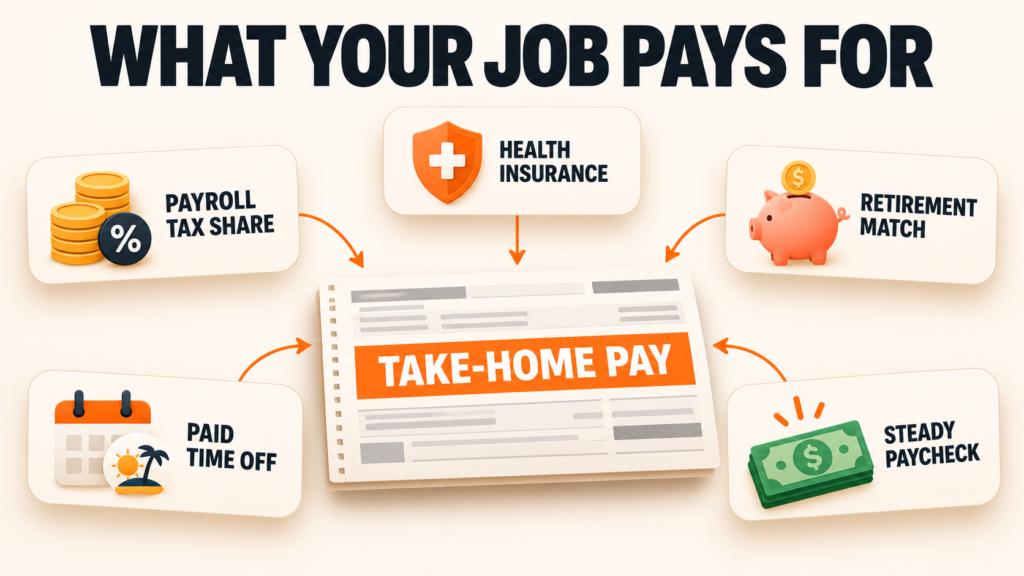
Here is what a salary usually pays for beyond take-home pay:
- Half of your payroll taxes, because your employer covers the other half
- A share of your health insurance premium
- A retirement match, if your company offers one
- Paid time off and sick days
- A steady paycheck that arrives whether or not you had a good month
Once you work for yourself, you pay both halves of those payroll taxes. The IRS calls this self-employment tax, and it is 15.3% on most of your net profit: 12.4% for Social Security and 2.9% for Medicare. It applies once you earn $400 or more from self-employment. You can read the details on the IRS self-employment tax page.
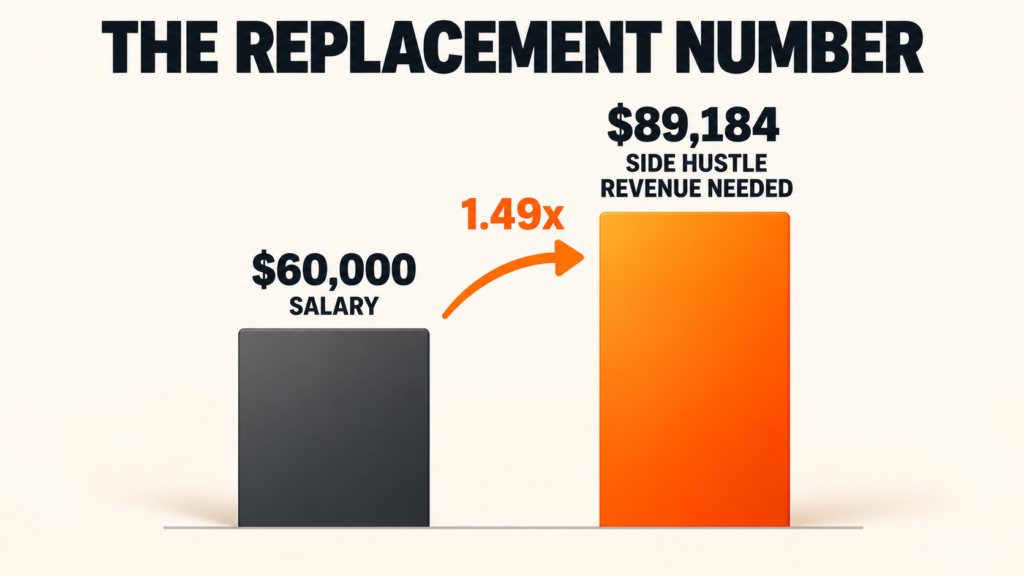
This is why I use what I call the Replacement Number. It is the amount of side hustle revenue you need to bring in to match what your job really gives you, after costs, self-employment tax and the benefits you will now pay for yourself.
Let’s run it on the $60,000 salary from earlier:
- Take-home after payroll tax: $55,410 a year
- Employer share of health insurance: about $7,885 a year, which is $657 a month
- A 3% retirement match: $1,800 a year
Add those together and the job is worth about $65,095 a year in after-tax value. To produce that from a side hustle with 15% costs and an effective self-employment tax rate of about 14.13%, you need roughly $75,806 in profit. That means about $89,184 in revenue, or around $7,432 a month. That is 1.49 times your salary, not 1.0 times.
Now compare that with a hustle that brings in exactly $60,000. After 15% costs you have $51,000 in profit. Self-employment tax takes about $7,206, leaving $43,794. Take away the $9,685 of health insurance and retirement you now fund yourself and you are left with $34,109. Your job was giving you $55,410. The gap is $21,301 a year.
Income tax applies on both sides, so I left it out to keep the comparison fair. If you want to estimate how much to put aside for it, how much to set aside for taxes on your side hustle covers it. Your costs also matter here, and what side hustlers can actually deduct on their taxes shows how to keep them honest.
You can still save for retirement without an employer. For 2026, the IRS limit for a traditional or Roth IRA is $7,500, and for a 401(k) it is $24,500.
Your Replacement Number is your salary multiplied by roughly 1.5, so find it before you do anything else.
The Health Insurance Gap Nobody Prices Until They Quit
Health insurance is the line item most people forget, because their job hides it so well. It leaves your paycheck in small pieces, and your employer pays the rest without ever sending you a bill.
Then you quit, and the bill arrives all at once. In 2025, the KFF Employer Health Benefits Survey found that the average annual premium was $9,325 for single coverage and $26,993 for family coverage. Workers paid about $1,440 of the single premium and about $6,850 of the family premium. Their employers covered the rest. You can read the full numbers in the KFF 2025 Employer Health Benefits Survey.
Here is what that means in real life. If you have single coverage, your pay stub may show around $120 a month for health insurance. The real cost of that plan is closer to $777 a month. Your employer was quietly paying the other $657. For family coverage, the pay stub figure is around $571 a month, while the real cost is closer to $2,249.
You have a few ways to replace it. Some people stay on their old plan through COBRA, which is usually the full premium plus an administrative fee, so it often feels like a big jump. Others buy a plan on the health insurance marketplace, join a spouse’s plan, or look at a plan from a professional association. The enhanced marketplace subsidies that lowered premiums expired at the end of 2025, so the help you may get now depends on your income and on where the cutoff for support sits. Check what is available for your income before you assume a number.
Take Maya, who earns $60,000 and has single coverage. She sees $120 a month leave her paycheck and thinks of that as her health insurance cost. When she prices a plan on her own, the quote is $650 a month. Her side hustle now has to cover $530 a month that she never noticed before, or $6,360 a year, before she has paid herself a cent.
Get a real quote for your own plan before you set a quit date, and add it to your Replacement Number.
The Consistency Test: One Great Month Is Not a Pattern
A great month feels like proof. It is easy to look at your best number and decide that is your new normal, but one strong month is only a data point.
The test that matters is whether you can hit your Replacement Number again and again. Side hustle income moves around more than a salary does. Seasons change, products go quiet, a platform tweaks something, and a slow month can follow a record one.
So I stopped asking what my best month was. I started asking what my average was, and what my worst month looked like. Your average shows you the pattern. Your lowest month shows you how much cash you would need to survive a bad stretch.
Here is a simple example. Say your Replacement Number is $7,432 a month, and your last six months looked like this: $5,100, $9,400, $6,200, $4,800, $8,900 and $5,600. Two of those months beat your number. Four fell short. The average is $6,667, which is about $765 a month below what you need. Your lowest month, $4,800, covered only about 65% of it.
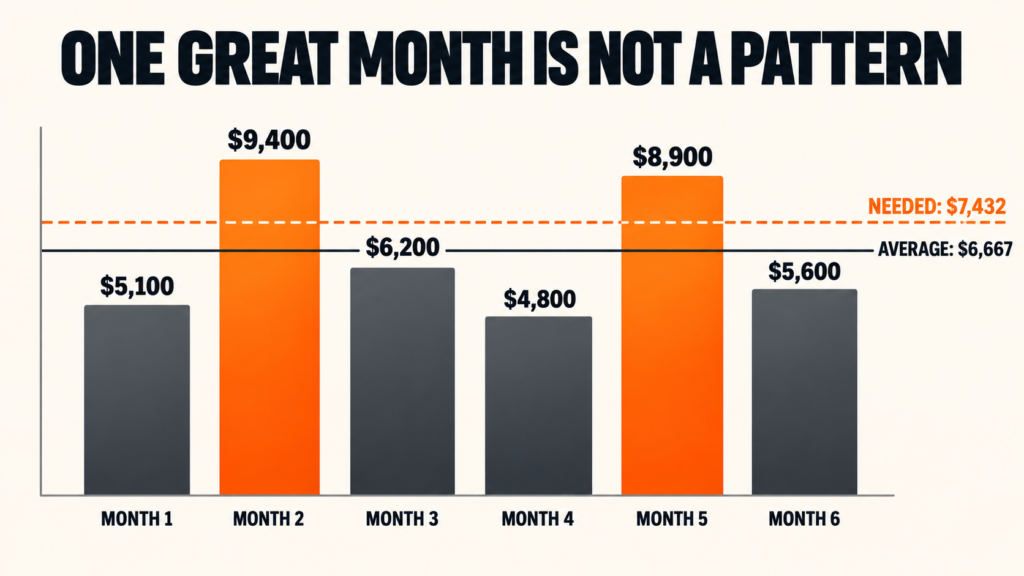
That is a hustle that looks strong and still is not ready. A few things can close the gap:
- Track every income source in one place, so you can see the real six-month average. How to track income from multiple side hustles shows a simple way to do it.
- Build a buffer for the slow months. How to build an emergency fund on variable income walks through how much to hold and where to keep it.
- Wait until your average, not your best month, reaches your Replacement Number.
A good rule of thumb is to look for six months in a row where your average clears the number, with no month dropping below about 70% of it. If that sounds strict, remember that your salary is the thing you would be giving up.
Judge your side hustle by its six-month average, never by its best month.
The Rehearsal: Live on Your Side Hustle Before You Quit
The best way to find out if you can quit is to act as if you already have. I call this the Rehearsal, and it is a three-month practice run that costs you very little.
Here is how it works. For three months, you pay yourself only from your side hustle, as if your job had already ended. Your real paycheck keeps arriving, but instead of spending it, you save it. If the rehearsal goes badly, you have lost nothing. If it goes well, you have a cash cushion and a clear answer.
Here are the steps:
- Pick your monthly pay. Use the after-payroll-tax figure from the Replacement Number. In our $60,000 example, that is $4,618 a month.
- Send all side hustle income to a separate account. If you do not have one yet, why you need a separate bank account for your side hustle explains how to set one up.
- Pay yourself on one fixed date each month, from that account only. No dipping into your salary to cover a shortfall.
- Set aside tax and health insurance first. Treat both as bills, because they will be once your job ends.
- Save your whole paycheck for the three months. That money becomes your safety net.
After three months, count the result. If you paid yourself in full every month, and your average held up, you passed. If you came up short in any month, you have learned that while your salary was still protecting you.
This is where the question I keep asking comes back: can this protect my present yet? A rehearsal answers it with real months instead of guesses. Passing does not mean you have to quit tomorrow. It means that when you do, you know your numbers.
If you pass, set a quit date, keep a few months of expenses in cash, and tell your employer on your terms. If you do not, keep the job, keep growing the hustle and run the rehearsal again in a few months.
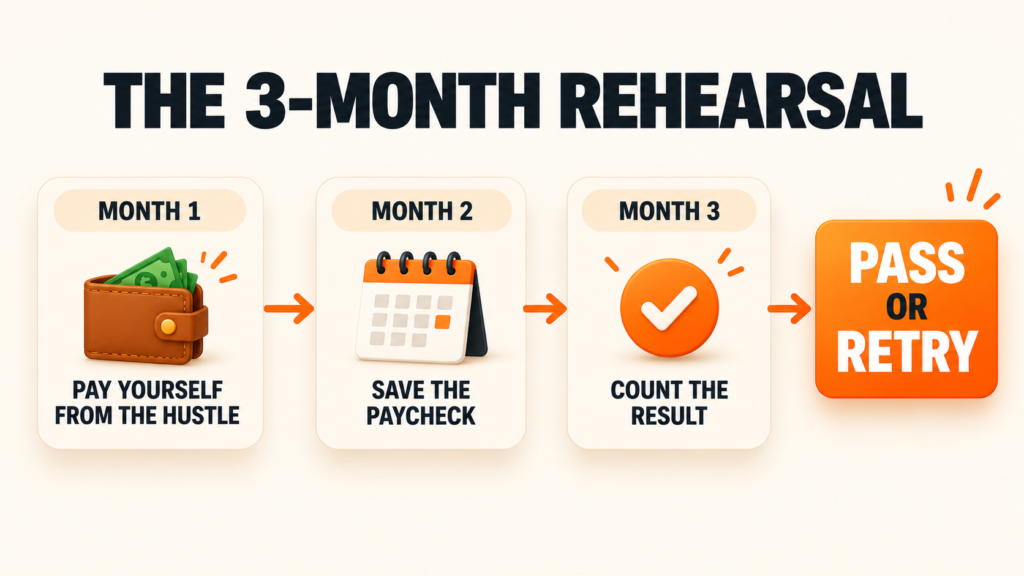
The Rehearsal turns a scary decision into a test you can pass or retry.
Final Thoughts
When your side hustle makes more than your job, it is a real milestone, and you should enjoy it. It tells you that people want what you are building.
It does not yet tell you that you can replace your salary. For that, you need three things: a Replacement Number that includes taxes and benefits, a six-month average that holds up, and a Rehearsal that proves you can live on it.
You do not have to rush any of it. Your job is still doing its work, and the longer your side hustle runs next to it, the stronger your numbers get.
Start this week by working out your own Replacement Number. Take your take-home pay, add what your employer pays for your health insurance and any retirement match, and multiply the total by about 1.37 to cover costs and self-employment tax. That gives you a revenue target to aim for.
Frequently Asked Questions
Should I quit my job if my side hustle makes more than my job?
Not until you have compared profit, not revenue, with your paycheck. Your job also pays for health insurance, half of your payroll taxes and often a retirement match. Check your Replacement Number first, then run a three-month Rehearsal before you decide.
How much does a side hustle need to make to replace a $60,000 salary?
In the example in this article, it needs about $89,184 in revenue a year, or around $7,432 a month. That covers 15% costs, self-employment tax, health insurance and a 3% retirement match. Your own number will differ, so use your take-home pay and your real insurance quote.
How long should my side hustle earn more than my job before I quit?
A good rule of thumb is six months in a row where your average clears your Replacement Number. Try to avoid any month falling below about 70% of it. A single record month is not a pattern.
What happens to my health insurance if I quit to work on my side hustle?
You lose the employer share of your premium, so the full cost lands on you. Your options usually include COBRA, a marketplace plan, or a spouse’s plan. Get real quotes before you set a quit date and add the monthly cost to your Replacement Number.
How much is self-employment tax on side hustle income?
It is 15.3% on most of your net profit: 12.4% for Social Security and 2.9% for Medicare. It applies once you earn $400 or more from self-employment. Your employer covers half of this when you have a job, which is why it feels like a surprise.